Government procurement can be one of the most valuable growth channels available to drone manufacturers, but winning contracts requires more than having a capable aircraft or an attractive price. Public-sector buyers typically evaluate suppliers through structured procurement processes where technical compliance, documentation, delivery capability, previous experience, support, risk and commercial terms all influence the final decision.
For manufacturers, this means the strongest technology does not always win. A company can offer an excellent drone and still lose because the submission is incomplete, the proposal does not clearly demonstrate compliance, the supporting documents are weak or the manufacturer has not built enough confidence around delivery and support.
The manufacturers that perform well in government procurement usually approach tenders as a repeatable commercial process rather than an occasional administrative task.
At Global Drones, we help drone and related technology manufacturers identify relevant tender opportunities, qualify them, prepare and coordinate tender documentation and support engagement with end clients. The objective is to help manufacturers compete more effectively while they remain responsible for their technology, pricing, customer contract, delivery and after-sales support.
Understand How Government Buyers Think
Government customers frequently evaluate risk differently from commercial buyers. A private company may be prepared to move quickly if it sees a compelling technology and a strong commercial benefit. Government procurement is usually more structured because buyers are responsible for public money, compliance requirements and operational continuity.
The buyer therefore needs confidence not only in the product but also in the supplier.
A government organisation may want to know whether the manufacturer can:
- Deliver the required system on time
- Meet every mandatory technical requirement
- Provide the required certifications
- Offer appropriate training
- Support the system after delivery
- Maintain spare parts availability
- Provide warranty coverage
- Protect sensitive data
- Demonstrate previous successful deployments
- Remain financially capable of supporting the contract
This means the tender response must present the manufacturer as a reliable long-term supplier rather than simply a company with interesting technology.
For drone companies moving into government sales for the first time, understanding this distinction is important. The proposal needs to reduce perceived risk while demonstrating technical value.
Find the Right Government Opportunities
One of the first mistakes manufacturers make is bidding for every tender that appears vaguely relevant.
That approach can consume enormous amounts of time.
Government procurement documents can be lengthy and preparation may require input from sales, engineering, finance, legal, operations and management. If the opportunity is poorly matched to the manufacturer’s capabilities, all of that effort may produce very little chance of success.
A better approach begins with systematic tender identification followed by qualification.
Relevant government opportunities can come from organisations such as:
- Police departments
- Fire and rescue services
- Civil protection agencies
- Defence organisations
- Border security agencies
- Government survey departments
- Environmental authorities
- Forestry organisations
- Municipal governments
- Transport authorities
- Universities and research organisations
- Public utilities
- Infrastructure operators
The procurement requirement may also be described in many different ways. Manufacturers should monitor more than just the word “drone.”
Useful search terminology might include:
- UAV
- UAS
- RPAS
- Uncrewed aircraft
- Aerial inspection
- Remote sensing
- Aerial LiDAR
- Thermal imaging
- Autonomous monitoring
- Survey system
- Mapping platform
- ISR system
- Drone-in-a-box
- Unmanned surveillance
The wider the understanding of the customer’s application, the better the manufacturer becomes at identifying relevant opportunities.
Global Drones can support this process by monitoring international opportunities and matching them against the capabilities of participating manufacturers.
Make Better Bid/No-Bid Decisions
Finding a tender is only the first step.
Before committing resources, manufacturers should make a structured decision about whether the opportunity is worth pursuing.
A Bid/No-Bid review should examine the entire opportunity rather than simply asking whether the product is technically suitable.
Questions should include:
- Can we meet every mandatory technical requirement?
- Are there specifications we only partially satisfy?
- Is the required delivery schedule realistic?
- Are overseas suppliers eligible?
- Is a local partner required?
- Are specific certifications mandatory?
- Do we have suitable references?
- Can we provide the required training and support?
- Is the available budget commercially attractive?
- Are the contract terms acceptable?
- Is there enough time to prepare a professional submission?
- Who are the likely competitors?
- Do we have a genuine probability of winning?
Manufacturers should be prepared to decline opportunities that do not make commercial or strategic sense.
This discipline can actually increase win rates because the company concentrates its resources on bids where it has a stronger competitive position.
Build a Detailed Compliance Matrix
One of the most useful tools in any government tender is the compliance matrix.
The tender documentation may contain hundreds of requirements spread across technical specifications, contractual documents, schedules, annexes and submission instructions. A compliance matrix brings these requirements into one central working document.
For each requirement, the tender team should record:
- The exact requirement
- Whether the manufacturer is compliant
- The evidence supporting compliance
- Who is responsible for the response
- Where the response appears in the proposal
- Any clarification required
A simple structure might classify requirements as:
- Fully compliant
- Partially compliant
- Non-compliant
- Information required
This prevents important requirements from being overlooked.
For drone manufacturers, the compliance matrix may include areas such as flight endurance, payload capacity, communications range, weather resistance, cybersecurity, operating temperatures, navigation systems, payload compatibility, training, warranty and delivery.
The process also exposes weaknesses early. If a mandatory requirement cannot be satisfied, management can decide whether there is a legitimate alternative solution or whether the tender should be abandoned before more resources are spent.
Make Technical Compliance Easy to Understand
Government evaluators may review many submissions.
The manufacturer’s job is therefore not simply to be compliant. It should make compliance easy for the evaluator to verify.
Avoid forcing the customer to search through product brochures to find evidence.
If the tender asks for a minimum flight endurance of 45 minutes, the response should clearly state whether the proposed aircraft achieves that requirement and provide supporting evidence.
If the buyer asks for a particular IP rating, operating temperature or payload capacity, answer the requirement directly.
The strongest tender responses usually follow the customer’s structure closely.
Instead of writing a generic sales brochure, answer what the buyer has actually requested.
This makes evaluation easier and reduces the risk that an important capability is overlooked.
Develop a Tender-Ready Documentation Library
Many government procurements request similar information.
Manufacturers can dramatically improve efficiency by creating a central tender library containing approved and current documentation.
This could include:
- Company registration information
- Company profile
- Technical datasheets
- Detailed system specifications
- Product certifications
- Insurance documentation
- Quality policies
- Cybersecurity policies
- Environmental policies
- Health and safety information
- Warranty documentation
- Training programs
- Maintenance procedures
- Customer references
- Case studies
- Previous project descriptions
- Standard company responses
Without this preparation, every tender becomes an emergency.
Salespeople request documents from engineering. Finance searches for certificates. Management tries to remember the details of previous projects. The tender team spends valuable time collecting information instead of improving the proposal.
A tender-ready manufacturer can respond much faster because the majority of standard information is already organised and approved.
Use Strong Customer References
Government buyers place significant value on previous experience.
A manufacturer may have technically superior technology, but if another bidder can demonstrate several successful deployments with similar organisations, the evaluator may consider that supplier lower risk.
Manufacturers should therefore build professional reference material from every successful deployment.
A strong reference should explain:
- Who the customer was
- What operational problem existed
- Which system was supplied
- How the solution was deployed
- What training was provided
- What results were achieved
- How ongoing support was managed
Where confidentiality allows, include measurable outcomes.
For example, instead of simply stating that a drone was supplied for infrastructure inspection, explain that the system helped the customer inspect a particular type of asset more efficiently, reduced exposure of personnel to hazardous environments or improved the frequency of inspection.
Government customers want evidence that the technology works operationally, not only in demonstrations.
Focus on the Customer’s Operational Problem
Drone manufacturers naturally want to talk about their technology.
Flight endurance, communications range, payload capacity, AI capabilities and autonomous functions are important, but government buyers are usually trying to solve an operational problem.
A police organisation may want faster situational awareness.
A fire service may need safer visibility over an incident.
A utility might want to inspect infrastructure without exposing employees to unnecessary risk.
An environmental agency could need repeatable data collection over a large area.
The proposal should therefore connect the technical capability directly to the operational outcome.
Instead of simply saying:
“Our system has a 60-minute endurance.”
Explain why that matters to the customer.
For example, the endurance may allow a larger inspection area to be completed in a single flight, reduce battery changes and improve operational efficiency.
Technology becomes more persuasive when the evaluator understands its practical value.
Make Training and Support Part of the Solution
Manufacturers sometimes treat training and after-sales support as secondary sections of a tender.
Government buyers may view them very differently.
A procurement organisation wants confidence that the technology will continue operating after delivery.
A sophisticated drone is of little value if operators cannot use it effectively or if technical problems leave systems grounded for weeks.
Manufacturers should explain clearly how they will provide:
- Initial operator training
- Refresher training
- Technical documentation
- Remote support
- Repair processes
- Spare parts
- Software updates
- Warranty support
- Escalation procedures
If local support is available through an authorised partner, explain that structure.
The goal is to show the customer that purchasing the system creates an operational capability rather than simply delivering hardware.
Take Cybersecurity Seriously
Cybersecurity is becoming increasingly important within government drone procurement.
Drones can collect sensitive imagery, mapping data, infrastructure information and operational intelligence. Government buyers therefore need confidence that the aircraft, communications system, software and data-storage environment are appropriately protected.
Manufacturers should expect questions about:
- Data encryption
- Communications security
- User access controls
- Cloud infrastructure
- Data storage location
- Software updates
- Vulnerability management
- Supply-chain security
- Component origin
- Security certifications
The importance of these requirements varies significantly between customers, particularly within defence and security markets.
Manufacturers targeting government contracts should therefore prepare clear and accurate cybersecurity documentation in advance rather than attempting to answer complex security questions at the last moment.
Provide Realistic Delivery Commitments
One of the easiest ways to damage credibility is to promise an unrealistic delivery schedule.
Government tenders frequently include specific deadlines. Manufacturers understandably want to demonstrate that they can meet the customer’s expectations, but committing to a schedule that cannot realistically be achieved creates significant risk.
Before approving a tender, confirm:
- Manufacturing lead time
- Component availability
- Payload availability
- Software configuration
- Shipping requirements
- Customs considerations
- Training schedules
- Installation requirements
- Acceptance testing
If local certification or export licensing is required, these factors should also be considered.
Government customers value certainty.
A realistic and well-supported delivery plan can be more credible than an aggressive promise the manufacturer may struggle to fulfil.
Price the Entire Solution, Not Just the Aircraft
Government buyers often compare the total cost of ownership rather than simply the purchase price of the drone.
Manufacturers should therefore consider all elements of the proposed solution.
These can include:
- Aircraft
- Payloads
- Ground control equipment
- Batteries
- Charging systems
- Software
- Training
- Shipping
- Installation
- Maintenance
- Spare parts
- Warranty extensions
- Technical support
A competitor with a lower aircraft price may actually provide a more expensive overall solution once these additional costs are included.
Manufacturers should clearly explain what is included and where the customer receives long-term value.
Pricing should also be checked carefully against the technical proposal. One of the most common tender problems occurs when the commercial schedule and technical response describe slightly different configurations.
Build Local Support Where It Adds Value
Government procurement can sometimes favour suppliers that demonstrate local market capability.
This does not always mean establishing a subsidiary.
Manufacturers may be able to work with local resellers, service partners, training providers or commercial representatives.
A local partner can potentially assist with:
- Customer communication
- Language
- Demonstrations
- Tender submission
- Local procurement knowledge
- Training
- Installation
- First-line technical support
However, the structure needs to be clear.
The customer should understand who is responsible for the product, who provides support and who ultimately holds the contract.
For the Global Drones model, manufacturers remain responsible for the technology, commercial agreement, delivery and after-sales support, while local support can be introduced where it strengthens the opportunity.
Ask Clarification Questions Early
Government tenders frequently include a formal clarification period.
Use it.
If a technical requirement is ambiguous, asking a question may prevent the manufacturer from making an incorrect assumption.
Clarifications can also help determine whether an alternative solution is acceptable.
However, questions should be professional and focused.
Do not wait until the final days of preparation to discover that an important requirement is unclear. The clarification deadline may occur significantly earlier than the submission deadline.
Tender managers should identify uncertainties during the initial compliance review and submit questions while there is still time to incorporate the answers into the proposal.
Improve the Quality of the Proposal
A government tender is not simply a collection of forms.
Where narrative responses are required, the quality of the writing matters.
Good tender writing should be:
- Clear
- Specific
- Evidence-based
- Customer-focused
- Consistent
- Easy to evaluate
Avoid excessive marketing language.
Statements such as “our revolutionary drone is the best solution on the market” provide very little value unless supported with evidence.
Instead, demonstrate why the proposed system satisfies the customer’s requirements.
Use technical evidence, previous deployments, test results and clear operational explanations.
The evaluator should finish reading the submission with confidence that the manufacturer understands the requirement and can successfully deliver the project.
Use a Formal Internal Approval Process
Before submission, every government tender should pass through a structured final review.
Technical teams should approve specifications and product claims.
Finance should approve pricing.
Operations should confirm delivery capability.
Management should approve significant commercial commitments.
Legal review may also be appropriate for contractual terms, liability, intellectual property, penalties and warranty obligations.
The final submission should then be checked against the compliance matrix to ensure every mandatory requirement has been addressed.
This process reduces risk for both the manufacturer and the customer.
It also prevents tender managers from accidentally committing the business to something that senior management has not approved.
Submit Early Where Possible
Tender portals do not care that your internet connection failed ten minutes before the deadline.
Government procurement deadlines are usually strict.
If a submission closes at 12:00, uploading at 12:01 may result in automatic rejection.
Manufacturers should therefore avoid treating the official deadline as the internal deadline.
A stronger process is to set an internal submission target at least a day earlier whenever possible.
This creates time to handle:
- Portal problems
- File-size limitations
- Incorrect document formats
- Missing signatures
- Upload errors
- Last-minute corrections
After submission, save the confirmation receipt and a complete copy of the final tender package.
Prepare for Clarification and Demonstration
The tender process often continues after submission.
Government buyers may ask clarification questions or request additional supporting evidence. Shortlisted manufacturers may also be invited to demonstrate their technology.
This stage should be treated as part of the original tender process rather than a separate sales activity.
The manufacturer should be prepared to respond quickly and consistently.
If the tender promised a particular feature, the demonstration should prove it.
If the customer asks a detailed technical question, the response should align with what was originally submitted.
Global Drones can help coordinate this stage by connecting the end client with the appropriate manufacturer contacts and supporting the flow of information as the procurement progresses.
Learn From Every Tender
Not every government contract will be won.
The important question is what the manufacturer learns from unsuccessful bids.
Where possible, request feedback or a procurement debrief.
Analyse areas including:
- Technical score
- Commercial score
- Compliance
- Customer references
- Proposal quality
- Delivery plan
- Support package
- Pricing
- Competitor strengths
Patterns will emerge over time.
Perhaps the manufacturer repeatedly loses points because it lacks local support. Maybe its warranty is weaker than competitors. Perhaps technical compliance is excellent but the proposal does not explain customer benefits clearly enough.
Each unsuccessful tender should improve the next one.
Companies that systematically review results can gradually increase their win rate.
Automate the Repetitive Parts
Tender preparation contains considerable repetition.
Manufacturers should automate as much of this work as reasonably possible.
A tender-management system can maintain approved information relating to:
- Company details
- Product specifications
- Certifications
- Standard responses
- Customer references
- Policies
- Previous submissions
New opportunities can then use this information as a starting point.
AI tools can also help extract requirements, build draft compliance matrices and prepare initial responses, provided all outputs are reviewed by qualified people before submission.
Automation should reduce administration, not replace technical or commercial judgement.
The goal is to allow the tender team to spend more time improving the quality of the bid and less time searching for documents.
How Global Drones Can Help
Global Drones is developing a dedicated tender-management and market-access model for drone manufacturers, payload manufacturers, software providers and related technology companies.
Our Manufacturer Program enables us to understand each participating company’s technology, applications and target markets.
Global Drones can then support several stages of the tender process, including:
- Identifying relevant global opportunities
- Qualifying tenders
- Supporting Bid/No-Bid decisions
- Coordinating documentation
- Preparing tender responses
- Managing deadlines
- Supporting submission
- Coordinating end-client communication
- Supporting clarification and demonstration stages
The manufacturer remains responsible for its product specifications, technical approval, pricing, quotations, contracts, delivery, warranty and after-sales service.
This structure allows manufacturers to increase their tender coverage without necessarily building a large internal bid department.
Winning More Government Contracts Is About Process
Government sales can sometimes appear complicated because of the amount of documentation and structure involved.
However, the fundamental principles are straightforward.
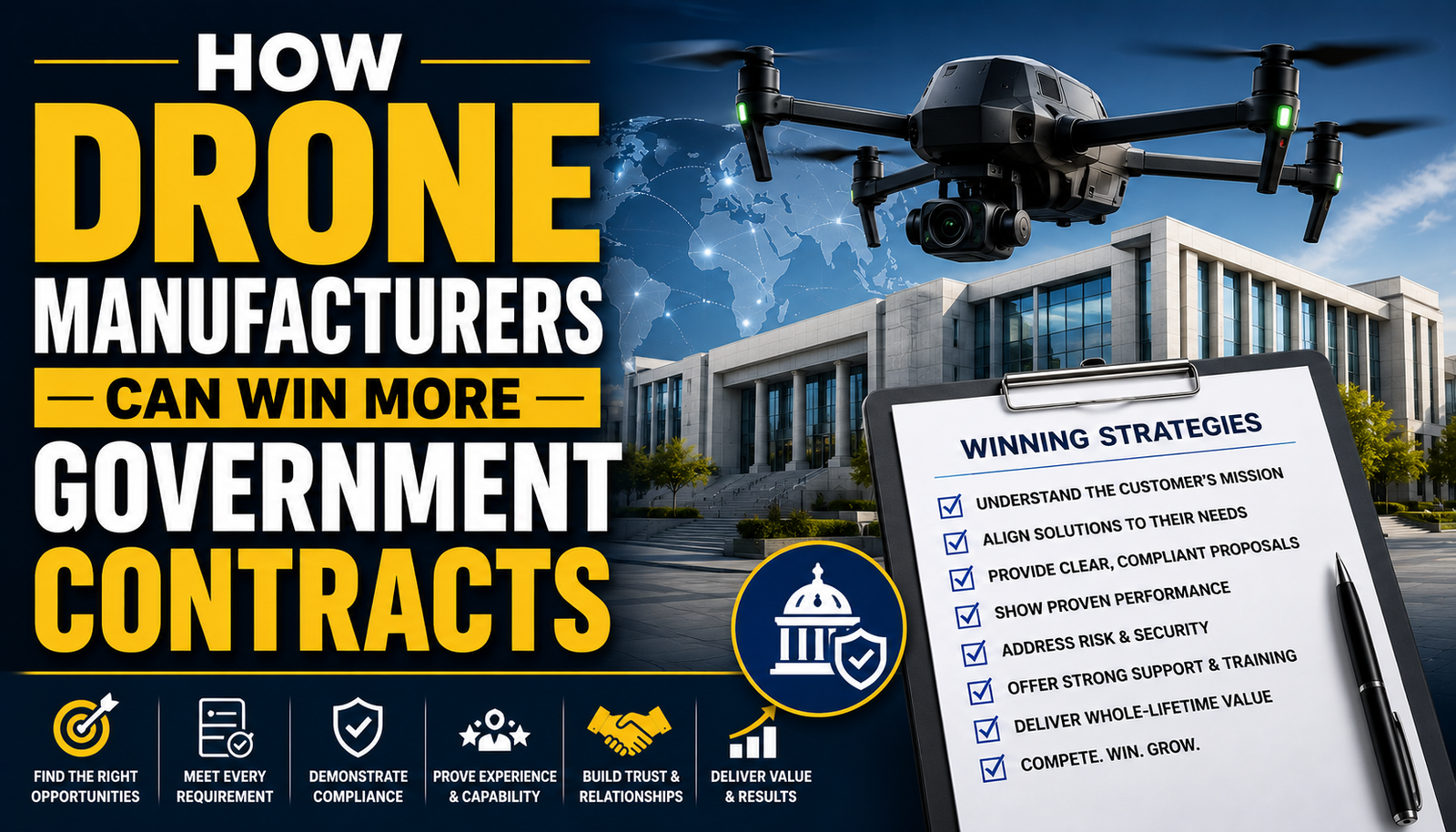
Manufacturers need to find suitable opportunities, select the right tenders, demonstrate compliance, reduce customer risk and provide strong evidence that they can deliver.
The companies that build this into a repeatable process become significantly better positioned than manufacturers that respond to tenders only occasionally.
A successful government tender strategy therefore combines:
- Strong technology
- Relevant opportunities
- Disciplined qualification
- Complete documentation
- Clear technical compliance
- Competitive pricing
- Strong references
- Reliable delivery
- Professional support
- Consistent tender management
No single element guarantees a contract.
Together, they create a much stronger proposition.
Turn Government Procurement Into a Growth Channel
Government contracts can provide drone manufacturers with much more than individual orders.
They can create recognised reference customers, long-term support revenue, repeat purchases and credibility within new industries and countries.
The first government customer can make the second easier to win. As references accumulate and tender processes improve, public procurement can develop into a significant international sales channel.
The challenge is ensuring that suitable opportunities are identified early and pursued professionally.
That is where Global Drones can support manufacturers.
We help identify relevant opportunities worldwide, support tender preparation and submission and connect manufacturers with end clients as procurement processes progress.
Manufacturers remain responsible for supplying, contracting, delivering and supporting their technology.
You build the technology. Global Drones helps you find and compete for the opportunities.
If your company manufactures drones, payloads, sensors, software or related technology and wants to pursue more government opportunities internationally, join the Global Drones Manufacturer Program.