The global drone industry is entering a new stage of commercial development. Drones are no longer technologies that organisations purchase simply to experiment with. Across government, defence, public safety, infrastructure, utilities, agriculture, surveying, environmental monitoring and research, unmanned systems are increasingly becoming part of normal operations.
For drone manufacturers, this creates a significant opportunity. However, having the right technology does not automatically mean manufacturers will see the opportunities when organisations are ready to purchase. A company can have an excellent drone, payload or software solution and still miss major contracts simply because its sales team never discovered the procurement requirement.
Global tender monitoring can help solve this problem.
Governments, utilities, universities, emergency services, infrastructure operators and other organisations regularly publish procurement opportunities for drones and related technologies. These tenders provide manufacturers with visibility into organisations that have identified a requirement and are actively looking for suppliers.
Monitoring these opportunities should therefore become part of the international sales strategy of many drone manufacturers.
At Global Drones, we help drone and technology manufacturers identify relevant tender opportunities around the world. We qualify opportunities against manufacturer capabilities, support the preparation and submission of tender documentation and help connect manufacturers with end clients when opportunities progress.
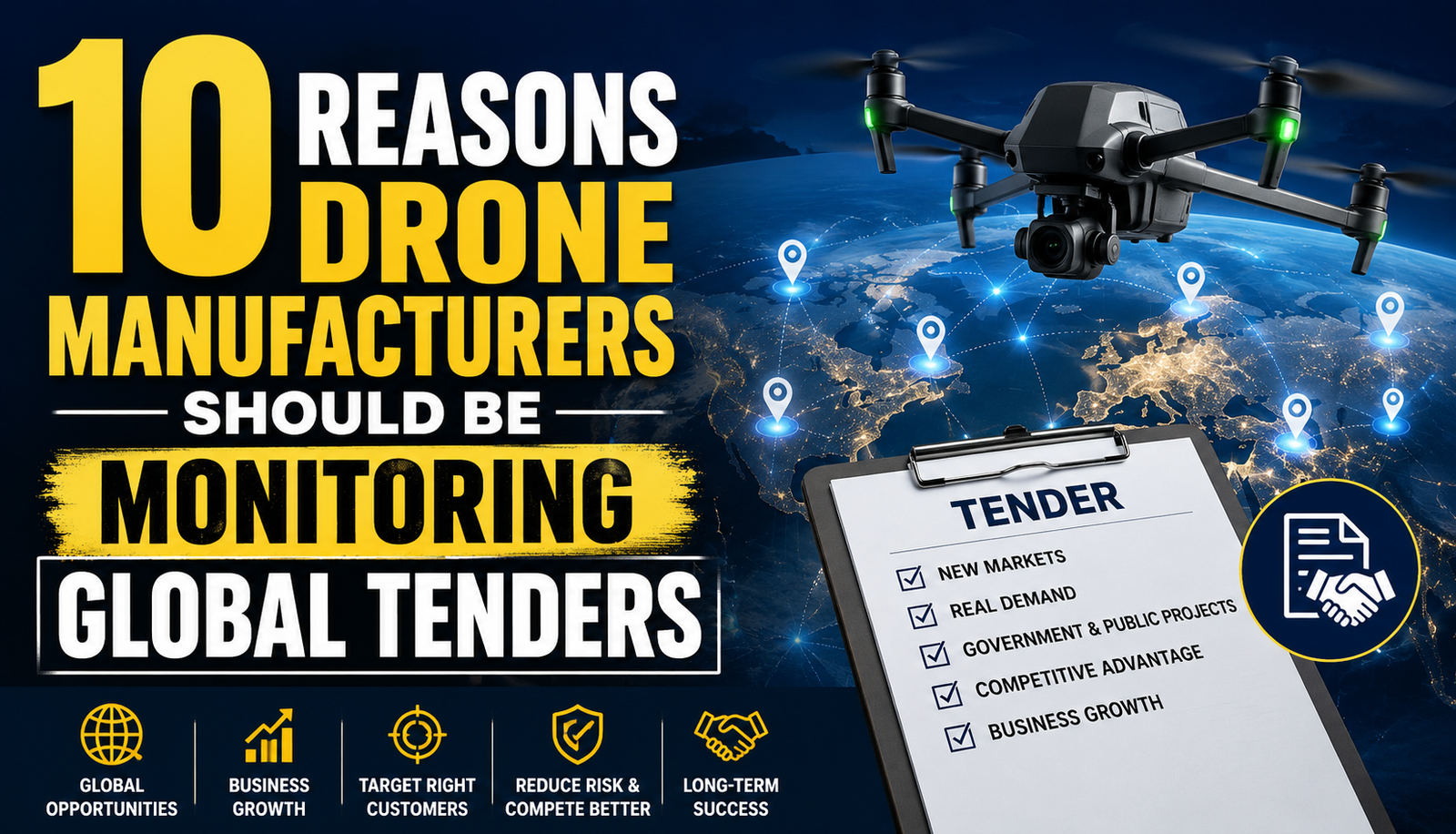
Here are ten important reasons why drone manufacturers should be monitoring global tenders.
1. Find Customers That Are Actively Looking to Buy
One of the greatest challenges in international sales is determining which organisations actually have an active requirement. There may be thousands of potential customers capable of using your technology, but only a relatively small percentage will be considering a purchase at any particular moment.
Traditional prospecting requires sales teams to identify potential customers, make contact, establish their requirements and determine whether a budget or project exists. This process can take months and often produces conversations with organisations that are interested in the technology but have no immediate intention of purchasing.
A published tender is very different. The customer has already taken an important step towards procurement. It has identified a requirement and has started looking for suppliers capable of meeting it.
Depending on the procurement, the customer may already have an approved project, budget, technical specification, required quantities, delivery schedule and evaluation process. The manufacturer is therefore starting with a considerably more qualified opportunity than a typical cold sales lead.
This does not mean every tender represents an easy sale. Manufacturers still need to compete, demonstrate compliance and provide a strong commercial proposition. However, knowing which organisations are actively purchasing allows sales resources to be concentrated where genuine demand exists.
For manufacturers trying to grow internationally, that visibility can be extremely valuable.
2. Discover Opportunities Outside Your Existing Sales Network
Most drone manufacturers have natural limits to their international reach. A company may have strong distributors in several countries, direct salespeople covering certain territories and good relationships within particular industries. Outside those areas, visibility can fall significantly.
Global procurement monitoring can expose manufacturers to customers they would otherwise never encounter.
A tender could be published by a regional electricity operator in Scandinavia, a university in Southern Europe, a forestry authority in Canada or an emergency service in Australia. Unless someone within the manufacturer or its distributor network is actively monitoring those organisations, the opportunity could easily be missed.
This is particularly important because the global market for drone technology is highly fragmented. There is no single group of customers buying every type of system. Different industries, government departments and regional organisations all have their own procurement processes.
Relevant opportunities can come from organisations including:
- Police and emergency services
- Fire and rescue organisations
- Defence and security agencies
- Electricity and utility companies
- Water authorities
- Rail infrastructure operators
- Ports and airports
- Universities and research institutes
- Environmental agencies
- Forestry organisations
- Surveying authorities
- Municipal governments
- Agriculture organisations
- Civil protection agencies
Systematically monitoring these markets can dramatically increase the number of potential customers visible to a manufacturer.
Global Drones is designed to provide this wider reach by identifying relevant opportunities internationally and matching them with manufacturers whose technology may satisfy the requirement.
3. Use Real Procurement Activity to Identify New Markets
Choosing which countries to enter is one of the most important decisions an international manufacturer makes.
Traditionally, market-entry decisions may be based on industry reports, competitor activity, distributor enquiries, exhibition attendance or general estimates of market potential. All of these can provide useful information, but tender activity adds another valuable source of evidence.
Procurement data shows where organisations are actually looking to purchase technology.
For example, imagine a manufacturer develops a VTOL drone designed for long-range infrastructure inspection. Over twelve months, the company sees multiple relevant procurement requirements appearing in the United Kingdom, Germany, Australia and Norway.
That activity provides evidence that organisations in those markets are investing in technologies matching the manufacturer’s capabilities.
The manufacturer can then investigate those countries in greater depth. It may decide to recruit a local partner, conduct demonstrations, attend a regional exhibition or invest in regulatory approvals.
This allows international expansion to become more opportunity-led. Instead of committing significant resources to a country and then looking for business, manufacturers can identify where purchasing activity already exists and concentrate resources accordingly.
Tender monitoring therefore becomes an important component of international market intelligence.
4. Create an Additional Sales Channel
Tender opportunities should not replace distributors, resellers or direct sales. They should complement them.
Many manufacturers rely heavily on one or two commercial channels. For example, a company might generate most of its international revenue through distributors. This can work extremely well, but it also means performance depends heavily on those partners consistently generating opportunities.
Another manufacturer might rely primarily on exhibitions and direct sales. Again, this can produce strong results but requires substantial time and resources.
Adding tender monitoring creates another source of qualified opportunities.
A diversified sales strategy could include:
- Direct manufacturer sales
- Distributors and resellers
- Strategic technology partnerships
- Manufacturer representatives
- Public-sector tenders
- Private-sector procurement
- International framework agreements
These channels can work together.
If Global Drones identifies an opportunity in a country where the manufacturer already has a strong reseller, that reseller can potentially support the opportunity locally. The manufacturer provides technical and commercial expertise, while the tender process creates another opportunity for the existing channel partner.
Tender monitoring therefore does not compete with a manufacturer’s distribution strategy. When managed correctly, it can strengthen it.
5. Understand What Customers Actually Want
Global tender monitoring provides much more than sales leads. It also creates an ongoing stream of market intelligence.
Procurement documents frequently contain detailed specifications describing exactly what customers expect from the technology they intend to purchase. Manufacturers can analyse these requirements to understand how market expectations are changing.
For example, customers may increasingly request:
- Longer flight endurance
- Greater payload capacity
- Higher IP ratings
- Wider operating temperature ranges
- Encrypted communications
- RTK or PPK positioning
- LiDAR compatibility
- Thermal imaging
- BVLOS capability
- Autonomous operation
- AI-based detection
- Cybersecurity compliance
- Local maintenance capabilities
- Training packages
- Extended warranties
One tender containing a particular requirement may not indicate a major trend. However, if the same capability appears repeatedly across multiple customers and countries, manufacturers should pay attention.
This information can support product-development decisions. Engineering teams can see which features customers increasingly consider essential. Product managers can identify potential technology gaps, while commercial teams can improve how products are positioned.
Tender intelligence can therefore influence not only sales strategy but also the manufacturer’s future product roadmap.
6. Identify New Applications for Existing Drone Technology
Drone manufacturers often develop products around a particular primary application. However, the same platform may have commercial potential across several different industries.
A long-endurance VTOL system developed for surveying could also be suitable for pipeline monitoring, forestry, border surveillance or environmental mapping. A thermal-equipped multirotor designed for industrial inspection could potentially support firefighting or search-and-rescue operations.
Manufacturers do not always discover these applications immediately.
Monitoring procurement requirements across different industries can reveal how organisations are trying to solve operational problems. A manufacturer may discover a tender requiring capabilities that its existing technology can already provide, even though the customer operates in a market the company has never previously targeted.
This can open entirely new vertical markets.
The manufacturer may subsequently develop new application material, case studies, payload integrations or partnerships specifically for that industry. It could also identify distributors with expertise in the new sector.
In this way, a tender that does not immediately result in a sale can still create valuable strategic insight.
7. One Tender Win Can Create Years of Additional Business
The value of winning a tender should not always be measured by the first purchase order.
Many organisations begin by purchasing a relatively small number of systems. Once the technology has been successfully deployed, additional purchases can follow.
A customer that initially purchases five drones might later require additional aircraft for other locations or departments. It may purchase new payloads, software licences, batteries, accessories or upgraded systems.
Long-term revenue opportunities can include:
- Additional drone systems
- Payload upgrades
- Spare parts and batteries
- Software subscriptions
- Training programs
- Maintenance contracts
- Extended warranties
- Replacement aircraft
- Technology upgrades
- Expansion into additional departments or locations
There is also considerable value in the reference itself.
Future tenders often require evidence of successful previous projects. A recognised government, utility, university or emergency-services customer can strengthen the manufacturer’s credibility when competing for similar contracts.
The first successful tender can therefore help create the evidence required to win future tenders.
Over time, manufacturers can build a portfolio of reference projects that makes them increasingly competitive within public procurement.
8. Strengthen Your Existing Distributor and Reseller Network
Manufacturers sometimes assume that pursuing tenders directly will create conflict with their existing channel partners. It does not have to.
Tender intelligence can actually become a valuable service for distributors and resellers.
Consider a manufacturer with an established reseller in France. Global Drones identifies a relevant French procurement requirement matching the manufacturer’s technology. Instead of competing with the reseller, the opportunity can potentially be pursued collaboratively.
Global Drones can support tender identification and coordination. The manufacturer can provide the technology, technical information and commercial terms. The reseller can provide local market knowledge, customer relationships and support where required.
This gives the reseller another qualified opportunity rather than expecting it to discover every potential project independently.
The same approach can help manufacturers identify gaps in their distribution network. If a strong opportunity appears in a country where the manufacturer has no representation, the company can determine whether local support is required and identify an appropriate partner.
Tender opportunities can therefore help activate existing sales channels while also revealing where new channel partners may be needed.
9. Learn More About Your Competitors
Tender monitoring can also provide manufacturers with valuable competitive intelligence.
Depending on the procurement system and country, information about contract awards may become publicly available. Manufacturers may be able to see which suppliers are winning contracts and, in some cases, understand aspects of the solutions selected.
Over time, this can reveal important market patterns.
A manufacturer might discover that one competitor is particularly successful within electricity utilities, while another has developed a strong position within emergency services. Certain product configurations or capabilities may repeatedly appear in winning solutions.
This information can help manufacturers evaluate their own competitive position.
If competitors consistently win tenders because they offer particular certifications, local support or technical capabilities, management can determine whether those areas require investment.
Conversely, tender requirements may reveal capabilities that the manufacturer’s technology satisfies particularly well. These can become important differentiators within future proposals and marketing.
Understanding why customers choose particular solutions is essential to improving win rates, and procurement intelligence can contribute significantly to that understanding.
10. Build a Repeatable International Sales Pipeline
The greatest value of global tender monitoring appears when it becomes systematic rather than occasional.
Finding one tender by chance may produce one opportunity. Continuously monitoring relevant procurement markets can create an ongoing pipeline.
The process begins with identifying opportunities and matching them against the manufacturer’s technology. Suitable opportunities are then qualified before the company commits resources to the bid.
Once a Bid/No-Bid decision has been made, the tender team prepares the necessary documentation, coordinates technical and commercial information, manages deadlines and supports the submission.
After submission, the process continues. Customers may request clarifications, demonstrations or additional documentation before making an award decision.
A structured tender process generally includes:
- Tender identification
- Initial qualification
- Bid/No-Bid decision
- Requirement and compliance review
- Document collection
- Proposal preparation
- Technical and commercial approval
- Tender submission
- Customer clarification and evaluation
- Contract award and sales handover
As manufacturers repeat this process, they become more efficient.
Standard documents can be reused. Approved answers can be stored. Certifications and company information can be maintained centrally. Successful proposals can provide templates for future submissions.
Instead of treating each tender as an entirely new project, manufacturers gradually build a professional tender capability.
The Challenge of Monitoring Tenders Internally
The case for tender monitoring is strong, but there is a practical problem. Someone has to do the work.
A typical growing drone manufacturer may have a relatively small commercial team. Salespeople are already managing distributors, talking to customers, conducting demonstrations, preparing quotations, attending exhibitions and developing partnerships.
Global tender monitoring can quickly become a full-time responsibility.
Procurement opportunities are spread across national government portals, regional authorities, utilities, universities, defence organisations, infrastructure operators and specialist procurement systems. Opportunities can also be published using terminology that does not explicitly mention drones.
A procurement notice might describe an unmanned aerial survey system, remote inspection solution, aerial LiDAR platform or autonomous monitoring capability.
Finding the opportunity therefore requires more than simply searching for the word “drone.”
Once found, the documentation must also be reviewed. A tender that initially appears relevant might contain a mandatory requirement the manufacturer cannot satisfy.
This is why qualification is just as important as discovery.
How Global Drones Supports the Process
Global Drones is building a dedicated tender and market-access service for drone manufacturers, payload manufacturers and related technology companies.
The first stage is our Manufacturer Program. Manufacturers provide information about their products, applications, technical capabilities and target markets. This gives us a clearer understanding of the types of opportunities relevant to each company.
Global Drones can then identify tender opportunities internationally and match them with suitable manufacturers. The objective is not to overwhelm manufacturers with hundreds of irrelevant procurement notices. The value comes from identifying opportunities that genuinely align with their technology and commercial strategy.
When a suitable tender is identified, the opportunity can be reviewed before deciding whether to participate. Technical requirements, deadlines, eligibility criteria and commercial considerations can all form part of this qualification process.
If the manufacturer decides to proceed, Global Drones can support the preparation and coordination of the tender documentation. Our team can help organise information, manage requirements and keep the submission process moving towards the deadline.
The manufacturer remains closely involved throughout. Technical specifications, pricing, quotations and contractual commitments ultimately require manufacturer approval.
Supporting the End Client
Submitting the tender is not necessarily the end of the sales process.
Customers may request additional technical information, demonstrations, meetings or clarification after reviewing the submission. In some procurement processes, shortlisted suppliers may be invited to presentations or negotiations before the final award.
Global Drones can help coordinate this stage and connect the end client directly with the manufacturer.
This is an important part of our model. We are not trying to replace the manufacturer within the customer relationship.
The manufacturer remains responsible for its technology, pricing, quotations, customer contract, delivery, warranty and after-sales support. Global Drones focuses on identifying the opportunity, supporting the tender process and helping the manufacturer progress the sale.
This allows manufacturers to increase their international opportunity coverage without giving up control of their customers or products.
Becoming Tender-Ready
Monitoring thousands of opportunities has limited value if the manufacturer cannot respond quickly when the right tender appears.
Manufacturers should therefore develop a tender-ready information library before opportunities arrive.
Core documentation should include:
- Company profile and registration information
- Product datasheets
- Detailed technical specifications
- Certifications
- Insurance documents
- Warranty information
- Training documentation
- Quality-management information
- Cybersecurity documentation
- Environmental policies
- Case studies
- Customer references
- Previous project information
Many procurement questions are repeated across different tenders. Preparing approved responses in advance can significantly reduce the workload associated with future submissions.
Instead of starting from an empty document every time, the tender team can concentrate on adapting existing material to the customer’s specific requirements.
The result is faster preparation, better consistency and potentially a stronger submission.
Global Tender Monitoring Is More Than Lead Generation
The real strategic value of tender monitoring becomes clear when the information is viewed collectively.
A manufacturer monitoring hundreds of relevant procurement opportunities can begin to see where the market is heading.
Which countries are purchasing more systems? Which industries are investing? What technical specifications are becoming standard? Which payloads are increasingly requested? Where is local support required? What certifications repeatedly appear?
This creates a valuable intelligence layer around the manufacturer’s international sales strategy.
Management can use actual procurement activity to decide where to invest, which partnerships to build and which product capabilities to prioritise.
Tender monitoring therefore becomes more than finding the next sales opportunity.
It becomes a way of understanding global demand.
Don’t Let the Right Opportunity Pass Unnoticed
The drone industry is expanding into an increasingly diverse range of operational applications. Utilities are using drones for infrastructure inspection. Emergency services are deploying systems for search and rescue and situational awareness. Surveying organisations are integrating LiDAR and photogrammetry into everyday workflows. Environmental agencies are using drones for monitoring, while security organisations are adopting increasingly autonomous platforms.
Many of these organisations purchase technology through structured procurement.
For manufacturers, the challenge is ensuring that when the right requirement appears somewhere in the world, someone identifies it.
The objective is not to submit a bid for every tender. It is to make sure the manufacturer sees the opportunities that genuinely match its technology and has the capability to pursue the strongest ones.
That is where systematic global tender monitoring can become a powerful growth tool.
Let Global Drones Find the Opportunities
Global Drones helps drone manufacturers, payload manufacturers and related technology companies identify and pursue relevant tender opportunities worldwide.
We find and qualify opportunities, support tender preparation and submission, and help connect manufacturers with end clients as opportunities progress.
Manufacturers continue to control their technology, pricing, customer contracts, delivery, warranty and after-sales support. Our role is to extend their commercial reach and help ensure valuable opportunities are not missed.
If your company manufactures drones, payloads, sensors, software or related technology and wants greater visibility into international procurement opportunities, join the Global Drones Manufacturer Program.
You build the technology. We help find the opportunities.