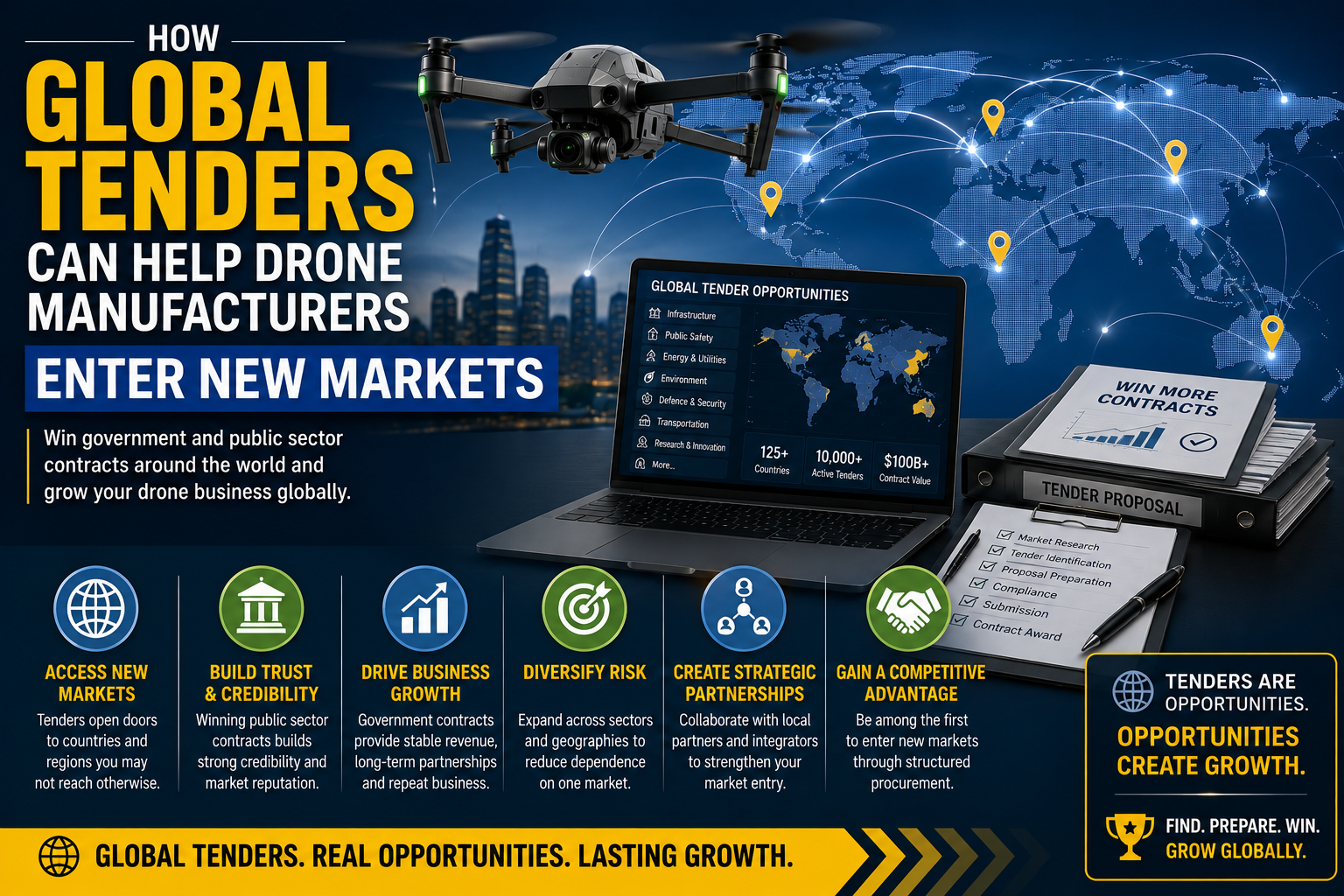
Expanding into a new country is one of the most difficult decisions a drone manufacturer can make. The opportunity may look attractive, but the cost of getting it wrong can be significant. Manufacturers may need to recruit distributors, find local representatives, attend exhibitions, translate marketing material, understand regulations, arrange demonstrations and invest in market development before knowing whether there is enough demand to justify the effort.
Global tenders offer another way to approach international expansion. Instead of entering a market first and then searching for business, manufacturers can identify real procurement opportunities and use them as evidence of where customers are already looking to buy.
This makes tender intelligence valuable for much more than individual sales. It can help drone manufacturers decide which countries to prioritise, which sectors are showing demand, what technical requirements are becoming important and where local partners may be needed.
At Global Drones, we help drone and related technology manufacturers identify relevant tender opportunities worldwide, qualify them against manufacturer capabilities, support tender preparation and help connect manufacturers with end clients as opportunities progress. Used properly, global tenders can become an effective route into new markets without requiring manufacturers to build large sales operations in every country from day one.
Enter Markets Based on Real Demand
Traditional market-entry strategies often begin with market research. Manufacturers look at economic data, industry reports, competitors, trade shows and distributor enquiries to decide where to expand.
All of this can be useful, but it does not always show where organisations are actively purchasing.
Tender activity provides a different type of evidence. If utilities, universities, government agencies, infrastructure operators or emergency services in a country are publishing procurement requirements for technology similar to yours, that is a clear signal that real demand exists.
For example, a manufacturer of VTOL drones may discover repeated tenders for long-range mapping or infrastructure inspection in Norway, Germany and Australia. A payload manufacturer may see increasing demand for LiDAR or thermal sensors in public-sector projects across the United Kingdom and Scandinavia.
That information can help management prioritise markets based on actual procurement activity rather than assumptions.
Test a Market Before Making a Major Investment
Entering a new country often involves fixed costs. A manufacturer may need to appoint a distributor, hire a sales representative, develop local marketing campaigns or establish support capability.
Global tender monitoring allows the company to test market attractiveness first.
If relevant tenders appear regularly in a country, the manufacturer gains a reason to investigate further. If almost no suitable opportunities appear over a long period, the market may require a different commercial approach.
This does not mean tender activity should be the only factor in market-entry decisions, but it can provide valuable evidence before significant investment is committed.
Manufacturers can use tender intelligence to decide whether to:
- Recruit a local distributor
- Appoint a commercial agent
- Find a service partner
- Attend an exhibition
- Conduct demonstrations
- Translate technical material
- Investigate local certification
- Build a local support structure
The key advantage is timing. Investment follows evidence of opportunity rather than preceding it.
Discover Which Sectors Are Buying
A country may have strong drone demand overall, but the opportunities may be concentrated in particular industries.
Tender monitoring helps manufacturers understand which sectors are driving procurement.
For example, one market may be seeing strong demand from electricity utilities, while another is investing heavily in public safety or environmental monitoring.
Relevant procurement may come from:
- Police and emergency services
- Defence and security organisations
- Electricity and utility operators
- Water authorities
- Rail infrastructure companies
- Airports and ports
- Universities and research organisations
- Environmental agencies
- Forestry organisations
- Municipal authorities
- Surveying organisations
- Agriculture organisations
This helps the manufacturer develop a more focused market-entry strategy.
Rather than approaching every possible customer, the commercial team can concentrate on the sectors where procurement activity is strongest.
Find Local Partners Around Real Opportunities
One of the biggest challenges in international expansion is finding the right local partner.
Manufacturers often recruit distributors before any real opportunity exists. The relationship begins with training, marketing support and expectations about future sales, but there may be no immediate project to pursue.
Tenders can reverse that sequence.
A manufacturer can first identify a strong opportunity and then find the local partner best suited to support it.
This creates a much more practical conversation.
Instead of saying, “Would you like to represent our products?”, the manufacturer can say, “We have identified a live opportunity in your market and are looking for a partner who can help support it.”
That can make partner recruitment faster and more commercially focused.
Potential local partners may include:
- Distributors
- Resellers
- Commercial agents
- System integrators
- Training companies
- Service providers
- Tender consultants
The right structure depends on the procurement and the customer.
Use Existing Distributors More Effectively
Manufacturers do not need to choose between tenders and distributors.
The two can work together.
If a manufacturer already has a local reseller, Global Drones can help identify opportunities in that territory and bring them into the sales process.
The distributor then provides local knowledge, language support, customer relationships or technical support where needed.
The manufacturer provides the technology, pricing and commercial approval.
Global Drones can coordinate the tender process.
This gives the distributor a qualified opportunity instead of requiring it to find every project independently.
For manufacturers, this creates a more active channel strategy and improves visibility into what is happening in each territory.
Learn Local Procurement Requirements
Every country has its own procurement environment.
Requirements may differ around business registration, taxation, insurance, language, local representation, digital signatures, security clearance and submission portals.
By monitoring and participating in tenders, manufacturers gradually learn what is required to compete successfully in each market.
This information can influence market-entry planning.
For example, repeated tenders may show that customers expect local maintenance support. Another country may allow overseas suppliers to bid directly. A different market may regularly require a local partner or specific certification.
This knowledge can help manufacturers build the correct commercial structure before investing too heavily.
Understand Local Technical Expectations
Tender documents also reveal how customer expectations vary between countries.
Some markets may place strong emphasis on weather resistance because of operating conditions. Others may prioritise communications security, cybersecurity, flight endurance, autonomous operation or specific payload integrations.
Repeated requirements may include:
- Flight endurance
- Payload capacity
- IP rating
- Operating temperature
- RTK or PPK
- LiDAR integration
- Thermal imaging
- Encrypted communications
- BVLOS capability
- AI-based detection
- Local data storage
- Training requirements
- Local technical support
This information can help manufacturers decide whether their existing product is ready for the market or whether modifications are required.
A tender may therefore identify not only a sales opportunity but also the changes needed to make the product competitive in that region.
Discover Opportunities Beyond the Word “Drone”
One of the challenges of global tender monitoring is terminology.
Customers do not always describe what they are buying as a drone.
A relevant procurement may be titled:
- Aerial inspection system
- Remote sensing platform
- Unmanned survey solution
- Autonomous monitoring system
- Aerial LiDAR capability
- Thermal inspection platform
- Remote infrastructure inspection
- Uncrewed aircraft system
Manufacturers that search only for the word “drone” risk missing valuable opportunities.
Understanding applications is therefore essential.
Global Drones can help manufacturers identify opportunities based on both technology and operational use case, increasing the chances of finding relevant projects in new markets.
Build Customer Relationships Before Establishing an Office
Manufacturers sometimes assume that entering a new country requires a physical presence.
In many cases, that is not necessary at the beginning.
A tender can create the first direct relationship with an important customer.
If the opportunity progresses, the manufacturer may participate in technical discussions, demonstrations or commercial meetings. This gives the company valuable exposure to the local market without immediately opening an office.
If several opportunities follow and the market proves attractive, the manufacturer can then make a more informed decision about permanent investment.
This creates a staged market-entry model.
First identify opportunities. Then build relationships. Finally invest where the business case is strongest.
Use Tender Wins to Build Credibility in a New Country
Winning the first contract in a new market can be difficult.
Customers may prefer suppliers with local references or previous experience.
However, once the manufacturer wins a significant project, the commercial situation can change quickly.
A recognised public-sector or infrastructure customer can provide credibility with future buyers.
The manufacturer can use the successful deployment to demonstrate:
- Local experience
- Delivery capability
- Training experience
- Technical support
- Operational performance
- Customer satisfaction
This reference can then strengthen future tender submissions and distributor conversations.
One successful tender can therefore become the foundation for broader market expansion.
One Contract Can Create Follow-On Business
The initial tender may be only the beginning.
A customer that purchases a small number of systems may later expand its deployment.
Future revenue can include:
- Additional drones
- Payload upgrades
- Software licences
- Spare batteries
- Training
- Maintenance
- Extended warranties
- Replacement systems
- Expansion into other regions
The customer may also influence other organisations.
Public-sector and infrastructure customers often communicate with peers. A successful deployment can therefore create visibility beyond the original contract.
This is why the strategic value of a tender can exceed the initial contract amount.
Tender Intelligence Helps Prioritise Sales Resources
Manufacturers rarely have unlimited sales resources.
Management has to decide where salespeople, marketing budgets and technical teams should focus.
Tender data can help make those decisions more objective.
If one region is producing frequent relevant opportunities while another is quiet, resources can be adjusted accordingly.
This may influence decisions around:
- Distributor recruitment
- Sales travel
- Demonstrations
- Trade shows
- Marketing campaigns
- Translation
- Certification
- Local support
Procurement activity becomes another metric for determining where the company should spend time and money.
Reduce the Risk of Expanding Into the Wrong Market
International expansion always carries risk.
A company can spend a year developing a market and discover that demand is weaker than expected.
Tender intelligence does not eliminate that risk, but it can reduce it.
By monitoring procurement before making major commitments, manufacturers gain visibility into customer activity.
This can help answer questions such as:
- Are organisations actually buying this type of technology?
- Which sectors are most active?
- How large are the opportunities?
- What specifications are common?
- Is local support required?
- Are overseas manufacturers eligible?
The more evidence management has, the better the expansion decision becomes.
Use Tenders to Build a Global Opportunity Map
Over time, tender monitoring can create a valuable picture of international demand.
Imagine tracking relevant procurement opportunities over several years.
The manufacturer could see which countries produce the most opportunities, which industries are investing and what the average project sizes look like.
This creates a global opportunity map.
Management can compare markets using real purchasing activity rather than relying entirely on broad industry forecasts.
The information can also highlight emerging markets before they become obvious through traditional sales channels.
Build a Repeatable Market-Entry Process
Global tender intelligence becomes most valuable when it is built into a repeatable process.
A manufacturer can use the same framework every time it evaluates a new market.
The process might include:
- Monitor procurement activity.
- Identify relevant opportunities.
- Assess local requirements.
- Evaluate technical fit.
- Identify local partners if needed.
- Make a Bid/No-Bid decision.
- Prepare and submit the tender.
- Engage with the customer.
- Review the market based on results.
- Invest further if demand is confirmed.
This turns market entry into a structured commercial process rather than a speculative exercise.
How Global Drones Supports International Market Entry
Global Drones is designed to help drone manufacturers, payload manufacturers, software providers and related technology companies identify international sales opportunities without immediately building large local sales teams.
Manufacturers joining our Manufacturer Program provide information about their products, applications, capabilities and target markets.
This allows us to search for opportunities that are genuinely relevant to each manufacturer.
Global Drones can support:
- Global tender identification
- Opportunity matching
- Initial qualification
- Bid/No-Bid coordination
- Tender document preparation
- Submission support
- Deadline management
- Local partner coordination
- End-client communication
- Opportunity tracking
Where a manufacturer already has a distributor or reseller, that partner can be incorporated into the process.
Where no local representation exists, the tender can help determine what type of partner is actually required.
The Manufacturer Remains in Control of the Sale
Global Drones supports the tender and market-access process, but the manufacturer remains responsible for the core commercial relationship.
The manufacturer controls:
- Technical specifications
- Product demonstrations
- Pricing
- Quotations
- Customer contracts
- Product delivery
- Training
- Warranty
- After-sales support
This structure allows manufacturers to expand their opportunity coverage while retaining control of their products and customers.
It also reduces the need to build a complete local commercial organisation before demand has been proven.
Combine Tender Intelligence With Channel Development
The strongest international strategy often combines global tender monitoring with channel development.
Tender intelligence shows where opportunities exist.
Local partners help manufacturers pursue those opportunities more effectively.
The manufacturer provides the technology and commercial expertise.
This creates a flexible international sales model that can adapt from country to country.
A market with strong direct procurement may require little local involvement.
Another country may need a reseller or system integrator.
A third may justify a permanent office once sufficient business has been established.
Tender intelligence helps manufacturers choose the right structure based on actual opportunities.
Enter New Markets Through Opportunity, Not Assumption
Traditional international expansion often begins with a territory.
Management decides it wants to enter a country and then begins building the necessary sales infrastructure.
Tender-led expansion starts with the opportunity.
A customer announces a requirement. The manufacturer evaluates the project, learns about the market and decides how much local support is needed.
This can make international expansion more focused and commercially disciplined.
The manufacturer does not need to abandon distributors, exhibitions or traditional business development. Instead, tender intelligence adds another source of information and qualified opportunities.
For growing drone companies, this can significantly improve the way international markets are evaluated.
Global Tenders Can Become Your Route Into the Next Market
The global drone industry is expanding rapidly, but demand is not distributed equally across every country and sector.
Manufacturers need ways to identify where customers are actually purchasing.
Global tenders provide one of the clearest signals.
They show which organisations have requirements, what capabilities they are asking for and when they intend to buy.
For manufacturers, that information can support much more than one sale. It can help identify new markets, activate distributors, discover new applications and guide international investment.
The objective is not to enter every country.
It is to identify the markets where your technology has the strongest commercial opportunity and build from there.
Let Global Drones Help You Find Your Next Market
Global Drones helps drone manufacturers and related technology companies identify relevant tender opportunities worldwide, qualify them and support the process from discovery through submission and end-client engagement.
We help manufacturers increase their international opportunity coverage while they remain responsible for their technology, pricing, contracts, delivery, warranty and customer support.
If your company is looking to expand internationally but wants to make market-entry decisions based on genuine customer demand, join the Global Drones Manufacturer Program.
Your next market may already be publishing the opportunity you are looking for.