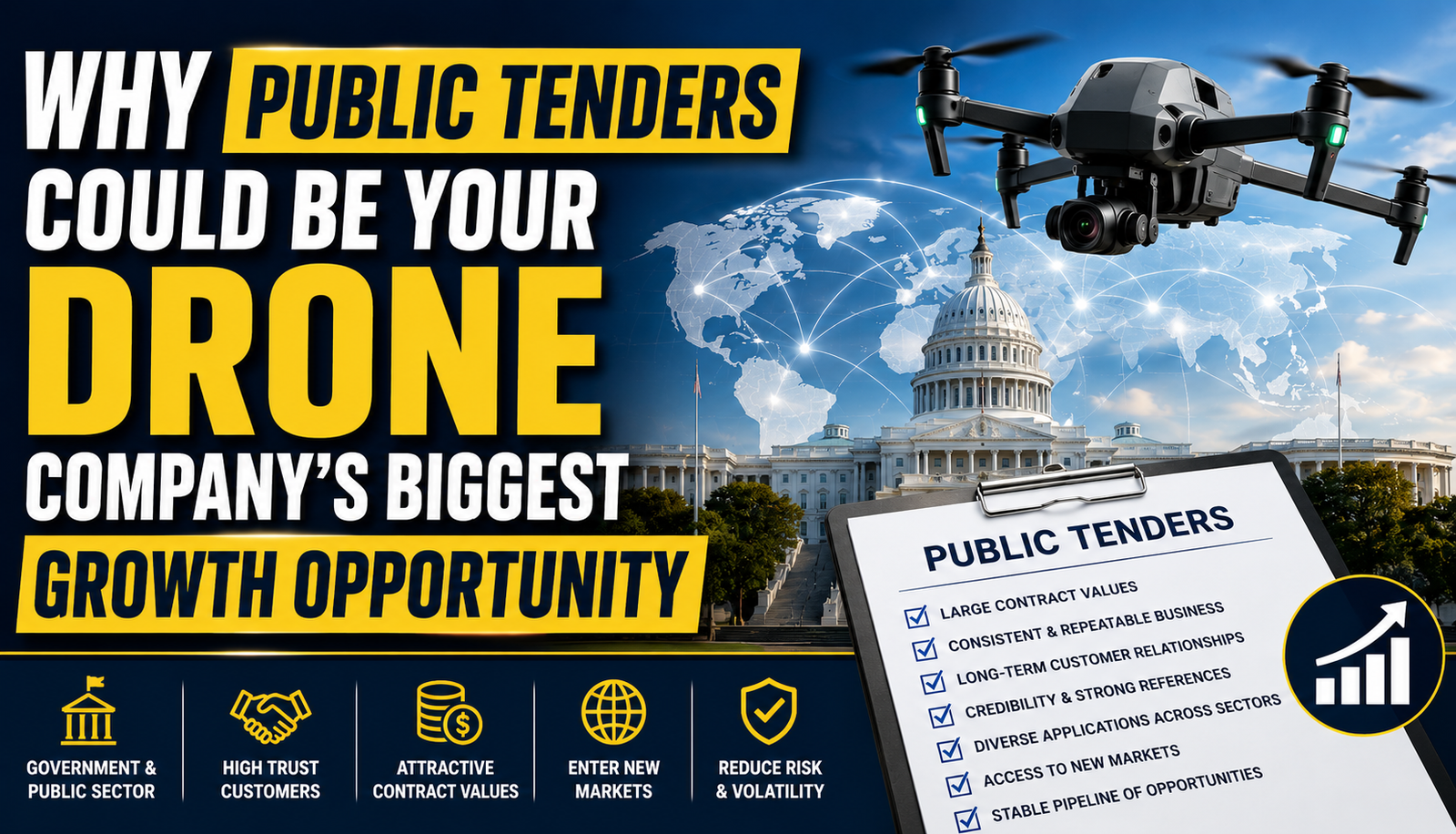
The global drone industry is moving from an emerging technology market into a mature commercial sector. Drones are now being used every day for infrastructure inspection, surveying, mapping, public safety, emergency response, agriculture, environmental monitoring, security, defence, research and many other applications. As adoption increases, so does the number of organisations looking to purchase professional drone systems.
For drone manufacturers, however, developing excellent technology is only part of the challenge. A company can build an innovative drone with impressive capabilities and still struggle to generate consistent international sales. Manufacturers need to find customers, identify projects, develop local relationships, build distribution channels and ensure they are visible when organisations are ready to purchase.
Public tenders can provide a powerful solution to part of this challenge. Governments, public authorities, utilities, universities, emergency services and infrastructure organisations regularly publish procurement requirements for drones, payloads, sensors, software and complete unmanned solutions.
These opportunities are particularly valuable because the customer has already identified a requirement. Instead of trying to persuade an organisation that it should consider using drone technology, manufacturers can compete for projects where the organisation has already decided that it needs a solution.
At Global Drones, we help drone and technology manufacturers identify these opportunities worldwide, qualify them against their capabilities, prepare and coordinate tender submissions and support engagement with end clients. For manufacturers looking to expand internationally, tenders can become much more than occasional sales leads. They can become an important and repeatable growth channel.
Public Procurement Is a Significant Market for Drone Technology
When drone manufacturers develop their international sales strategy, the first discussion often revolves around distributors and direct sales. Both remain extremely important, but there is another large market operating alongside them: procurement.
Public organisations purchase enormous quantities of technology every year. As drones become integrated into everyday operations, more of this spending is moving towards unmanned systems and the technologies surrounding them.
Potential buyers include:
- Police and law enforcement organisations
- Fire and rescue services
- Civil protection agencies
- Defence organisations
- Border and maritime authorities
- Electricity transmission operators
- Water authorities
- Rail infrastructure organisations
- Ports and airports
- Environmental agencies
- Forestry departments
- Universities and research institutes
- Municipal authorities
- Surveying and mapping organisations
- Government departments
These organisations are not necessarily purchasing a drone as an isolated product. Many are looking for complete capabilities.
A utility company might require an inspection solution consisting of an aircraft, camera, software, training and technical support. A university could require a drone combined with a LiDAR payload and specialist processing software. An emergency service might seek an autonomous drone system capable of rapidly providing aerial situational awareness.
This means tender opportunities exist across the entire drone technology ecosystem, including aircraft manufacturers, payload manufacturers, software developers, communications companies and specialist system integrators.
The Customer Has Already Identified a Need
One of the biggest advantages of a tender is that much of the earliest sales qualification has already taken place.
Traditional business development frequently starts with identifying an organisation that could potentially benefit from your technology. The sales team then needs to establish contact, understand the organisation’s challenges, create interest and determine whether a purchasing project actually exists.
This process can take months or even years.
A tender represents a very different situation. The organisation has typically identified a requirement and formally started a procurement process. In many cases, it will already have established technical requirements, quantities, delivery expectations and evaluation criteria.
The procurement may define:
- Required technology
- Technical specifications
- Quantities
- Delivery schedules
- Training requirements
- Warranty requirements
- Evaluation criteria
- Submission deadlines
- Contract conditions
From a manufacturer’s perspective, this represents a highly valuable sales signal. The customer is not simply researching drone technology. It is actively asking the market to provide a solution.
Manufacturers still need to determine whether they can compete successfully, but they are beginning with a genuine commercial opportunity rather than a speculative sales lead.
Tenders Can Help You Enter New Countries
International expansion is one of the most expensive parts of growing a drone company. Entering a new country can require distributors, salespeople, exhibitions, demonstrations, translations, regulatory research and potentially local infrastructure.
Making these investments before understanding the level of demand carries considerable risk.
Tender intelligence can provide manufacturers with another way of identifying promising markets.
Imagine that a European drone manufacturer begins monitoring procurement activity internationally. During the next twelve months, it identifies multiple relevant opportunities in Australia, Germany, the United Kingdom, Norway and Canada.
That information provides evidence that organisations in those countries are actively purchasing technology similar to the manufacturer’s systems.
The manufacturer can investigate those markets more closely before committing significant resources. It may discover that one country is generating substantially more opportunities than another and decide to concentrate its expansion efforts accordingly.
The company could then:
- Recruit a local sales partner
- Appoint a distributor
- Arrange demonstrations
- Attend a relevant exhibition
- Translate sales material
- Investigate local certifications
- Develop local customer references
- Build strategic partnerships
This allows international expansion to become more opportunity-driven.
Rather than establishing a presence in a market and then searching for opportunities, manufacturers can identify demand first and invest where the commercial evidence is strongest.
Public Tenders Can Diversify Your Sales Pipeline
Many drone manufacturers become heavily dependent on a relatively small number of distributors or customers.
Strong channel partners can generate substantial business, but dependence creates vulnerability. A distributor may change priorities, lose salespeople, introduce competing products or simply fail to develop the market as expected.
The same applies to major direct customers. If a manufacturer relies on several large projects and one is postponed, annual revenue can be affected significantly.
Tender opportunities provide another source of business.
A balanced international sales strategy might include:
- Direct sales
- Distributors
- Resellers
- Manufacturer representatives
- Strategic technology partnerships
- Public tenders
- Private procurement opportunities
These channels can support each other.
A tender identified in a country where the manufacturer already has a distributor can be passed to that local partner for support. Alternatively, a strong opportunity in a country without representation may provide the reason to recruit a new local partner.
Public procurement therefore does not need to replace the manufacturer’s existing sales structure. It can strengthen and diversify it.
One Tender Can Become a Much Larger Customer
The value of a tender should not always be judged solely by the size of the initial contract.
Many organisations begin drone programs gradually. A customer may initially purchase a small number of aircraft to evaluate the technology operationally. If the deployment proves successful, additional purchases can follow.
Future revenue could include:
- Additional aircraft
- Additional payloads
- Batteries and accessories
- Ground control equipment
- Software licences
- Training
- Maintenance
- Replacement systems
- Extended warranties
- Technology upgrades
The manufacturer may also gain access to other departments within the same organisation.
A successful deployment with one regional electricity team, for example, could eventually lead to interest from other operating regions.
The reference itself also has substantial value.
Future tenders frequently ask bidders to demonstrate previous experience delivering comparable projects. A successful deployment with a government organisation, utility, university, emergency service or infrastructure operator can significantly strengthen future submissions.
The first tender win can therefore help the manufacturer win the second, third and fourth opportunities.
Over time, successful procurement projects can create an increasingly powerful portfolio of reference customers.
Tenders Can Reveal What the Market Really Wants
Another major benefit of tender monitoring is market intelligence.
Procurement specifications tell manufacturers exactly what customers are requesting from suppliers. Analysing these requirements over time can reveal important trends.
For example, manufacturers may begin seeing repeated requirements for:
- Increased flight endurance
- Greater payload capacity
- Higher IP ratings
- Wider operating temperatures
- Encrypted communications
- RTK or PPK positioning
- LiDAR integration
- Thermal imaging
- BVLOS capability
- Autonomous operations
- AI-based detection
- Cybersecurity compliance
- Local technical support
- Extended warranty periods
A single customer requesting a particular feature may not indicate a major change in the market. However, if the same requirement appears repeatedly across several countries and industries, it becomes strategically important.
This information can influence future product development.
Engineering teams can see which capabilities customers increasingly consider essential. Product managers can identify potential gaps. Business development teams can determine which integrations or partnerships could strengthen the manufacturer’s position.
Tender monitoring therefore provides more than sales opportunities. It creates direct insight into customer demand.
Discover New Applications for Your Existing Technology
Manufacturers sometimes discover that their technology is suitable for industries they never originally targeted.
A VTOL aircraft developed for surveying might also be suitable for pipeline monitoring, forestry or environmental mapping. A thermal-equipped drone designed for industrial inspection could potentially support emergency services. A drone-in-a-box system developed for security could have applications within utilities or infrastructure monitoring.
Tender monitoring can reveal these opportunities.
When organisations describe the operational problem they are trying to solve, manufacturers can evaluate whether existing technology could meet the requirement.
This can expose the business to completely new sectors.
A newly discovered application could eventually result in:
- New application pages on the manufacturer’s website
- New marketing campaigns
- New payload integrations
- New industry partnerships
- New distributors
- Product modifications
- New sales territories
Even tenders that are not pursued can therefore provide useful commercial intelligence.
Why Manufacturers Miss Valuable Tenders
The main problem with global tender opportunities is finding them.
Procurement is fragmented across thousands of organisations and platforms. Different countries have their own systems, while utilities, universities, infrastructure operators and other organisations may use separate procurement portals.
Terminology also varies considerably.
A relevant opportunity may not contain the word “drone” at all. Customers may describe requirements using terms such as:
- Unmanned aerial system
- Remote inspection solution
- Aerial survey platform
- Remote sensing system
- Autonomous monitoring solution
- Aerial LiDAR system
- Uncrewed aircraft
- Infrastructure inspection technology
A manufacturer searching only for “drone tenders” could therefore miss valuable opportunities.
There is also the question of resources.
A growing drone manufacturer may have only a few salespeople. Those individuals are already managing distributors, customers, exhibitions, demonstrations, quotations and partnerships.
Expecting them to continuously monitor procurement systems around the world is often unrealistic.
As a result, opportunities can be published, evaluated and awarded without the manufacturer ever knowing they existed.
This is one of the key problems Global Drones is designed to address.
Finding the Tender Is Only the Beginning
Discovering an opportunity does not automatically mean the manufacturer should bid.
Every tender needs to be qualified.
Submitting a professional tender can require significant time and resources, so manufacturers should concentrate on opportunities where they have a realistic chance of success.
Important questions include:
- Does the product meet the mandatory technical requirements?
- Can the manufacturer deliver within the required timeframe?
- Are international suppliers permitted?
- Is local representation required?
- Are specific certifications required?
- Can the manufacturer satisfy warranty requirements?
- Does the company have suitable customer references?
- Can the required training and support be provided?
- Is the opportunity commercially attractive?
- Is there a realistic probability of winning?
This should result in a clear Bid/No-Bid decision.
One of the biggest mistakes manufacturers can make is bidding for everything. A smaller number of carefully selected and professionally prepared submissions will often provide greater value than responding to every opportunity available.
Global Drones can support this qualification process by matching opportunities against manufacturer capabilities before substantial resources are committed.
Preparing a Tender Requires More Than a Product Datasheet
Once the decision to bid has been made, the preparation process begins.
Public tenders can require significant amounts of information. The exact requirements vary, but manufacturers may need to provide technical, commercial, financial and administrative documentation.
A submission could require:
- Company information
- Technical specifications
- Product datasheets
- Compliance matrices
- Pricing schedules
- Delivery plans
- Training proposals
- Warranty information
- Maintenance plans
- Insurance certificates
- Quality certifications
- Cybersecurity documentation
- Environmental policies
- Financial information
- Previous project references
- Signed declarations
The challenge is not simply gathering these documents. The entire proposal needs to be accurate, consistent and tailored to the customer’s requirements.
A strong product does not automatically create a strong tender.
If a mandatory document is missing, a specification is unclear or a question is not answered correctly, the manufacturer could lose an opportunity despite having technically superior technology.
Professional tender management therefore matters.
Build a Tender-Ready Manufacturer
Manufacturers planning to pursue public procurement regularly should create a tender library before opportunities arrive.
Many procurement questions are repeated. Customers frequently request similar information about company history, product capabilities, quality procedures, cybersecurity, warranty, training and technical support.
Preparing approved information in advance makes future submissions significantly faster.
A strong tender library might contain:
- Company profile
- Company registration documents
- Product datasheets
- Detailed specifications
- Certifications
- Insurance documents
- Warranty information
- Training documentation
- Cybersecurity policies
- Quality policies
- Environmental policies
- Case studies
- Customer references
- Previous project information
- Standard tender responses
Instead of starting from zero every time, the tender team can adapt existing approved content to the particular procurement.
This reduces preparation time and improves consistency.
It also allows the manufacturer to react quickly when an attractive opportunity appears with a relatively short deadline.
How Global Drones Supports Manufacturers
Global Drones is building a global tender and market-access service specifically for drone manufacturers, payload manufacturers and related technology companies.
Manufacturers can join our Manufacturer Program and provide information about their products, applications, capabilities and target markets. This allows our team to understand what types of opportunities are relevant to each company.
We then identify relevant public and private tender opportunities internationally and match them against manufacturer capabilities.
When an opportunity is identified, the first objective is to determine whether it is genuinely worth pursuing. We can help review requirements and coordinate the Bid/No-Bid process before significant resources are committed.
For opportunities that proceed, Global Drones can support the preparation, management and coordination of the tender documentation and submission process.
This allows manufacturers to expand their tender activity without necessarily creating a large internal tender department.
The Manufacturer Remains in Control of the Sale
An important part of the Global Drones model is keeping the manufacturer connected directly with the customer.
Our role is to find and help manage opportunities, not to replace the manufacturer.
Global Drones can support areas including:
- Tender discovery
- Opportunity qualification
- Document preparation
- Bid coordination
- Deadline management
- Submission support
- Customer communication coordination
The manufacturer remains responsible for its core commercial and technical responsibilities, including:
- Product specifications
- Technical approval
- Demonstrations
- Pricing
- Quotations
- Contracts
- Delivery
- Training
- Warranty
- After-sales support
When an end client requires a technical meeting, demonstration or detailed discussion, Global Drones can help connect the customer directly with the manufacturer.
The manufacturer therefore retains control of the customer relationship and ultimately delivers the solution.
Grow Internationally Without Building a Huge Tender Department
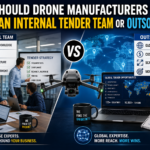
Creating an internal global tender capability can be expensive.
A manufacturer may need people dedicated to monitoring opportunities, reviewing requirements, writing proposals, gathering documentation and managing submission deadlines.
For larger organisations, maintaining an internal bid team may make sense. For smaller and medium-sized drone manufacturers, outsourcing parts of the process can provide a more scalable approach.
The manufacturer can continue concentrating its internal resources on product development, demonstrations, technical sales and customer delivery while Global Drones expands the company’s visibility into procurement opportunities.
This is particularly valuable when manufacturers want to explore multiple international markets simultaneously.
Instead of employing tender specialists in every region, the company can use a centralised tender-management approach supported by local partners where necessary.
Tender Success Should Be Viewed Long-Term
Public tenders are not guaranteed sales.
Some opportunities will attract significant competition. Others may favour incumbent suppliers or require capabilities the manufacturer cannot provide. Procurement processes can also be delayed, changed or cancelled.
The objective should therefore be to develop a consistent pipeline rather than expecting every tender to result in a contract.
Manufacturers that become successful within public procurement continually improve their process.
They learn which opportunities are worth pursuing. They improve their standard documentation. They build stronger references. They become faster at responding to requirements and better at demonstrating compliance.
Over time, tender management becomes an established sales capability.
The manufacturer may start by pursuing only a handful of opportunities each year. As processes improve, it becomes possible to evaluate and pursue significantly more opportunities without increasing the workload proportionally.
Public Tenders Can Become a Strategic Growth Channel
The biggest opportunity is not one individual tender.
It is the ability to create a repeatable system for identifying organisations around the world that are actively purchasing technology.
For a drone manufacturer, this can fundamentally expand the sales pipeline.
Instead of relying entirely on distributors to discover opportunities, the manufacturer gains another source of intelligence. Instead of selecting international markets purely on assumptions, procurement activity provides evidence of demand. Instead of cold prospecting every potential customer, the sales team can focus additional attention on organisations with identified projects.
Tender intelligence can therefore support:
- Lead generation
- International expansion
- Distributor development
- Market intelligence
- Product strategy
- Competitive analysis
- Customer acquisition
- Long-term sales growth
This is why public tenders deserve to be considered as part of a manufacturer’s broader international commercial strategy.
The Opportunity Ahead for Drone Manufacturers
The use of drones continues to expand into increasingly important operations.
Utilities are adopting unmanned systems for inspection. Emergency services are using drones for search and rescue and situational awareness. Surveying organisations are integrating LiDAR and photogrammetry into everyday workflows. Environmental organisations are monitoring large areas with aerial sensors. Security organisations are adopting autonomous systems, while universities and research institutions continue to develop new applications.
As these markets mature, structured procurement will become increasingly important.
The manufacturers best positioned to benefit will be those capable of identifying opportunities early and responding professionally when customers enter the market.
The objective is not to participate in every tender.
It is to make sure that when an organisation somewhere in the world publishes a requirement that perfectly matches your technology, your company knows about it.
Let Global Drones Find the Opportunities
Global Drones helps drone manufacturers, payload manufacturers, software companies and related technology providers identify and pursue relevant tender opportunities worldwide.
We find and qualify opportunities, support tender preparation and submission and help connect manufacturers with end clients as opportunities progress.
Manufacturers continue to control their products, pricing, customer contracts, delivery, warranties and after-sales support. Global Drones provides the additional tender capability needed to extend their international reach.
For manufacturers that want to grow internationally without building a large tender operation internally, this creates a simple proposition.
You focus on building and supporting great technology. We focus on helping you find the opportunities to sell it.
If your company manufactures drones, payloads, sensors, software or related technology, join the Global Drones Manufacturer Program and start accessing more international tender opportunities.