For many drone manufacturers, the biggest problem is not finding a tender. It is discovering a strong opportunity and then realising the company is not ready to respond properly.
A relevant tender may appear with a submission deadline only a few weeks away. The opportunity fits the product, the customer is attractive and the contract value is significant, but internal information is scattered across departments. Certifications are difficult to locate, customer references are incomplete, insurance documents are out of date and the sales team has to ask engineering for technical details that should already be available.
By the time everything is collected, much of the submission period has disappeared.
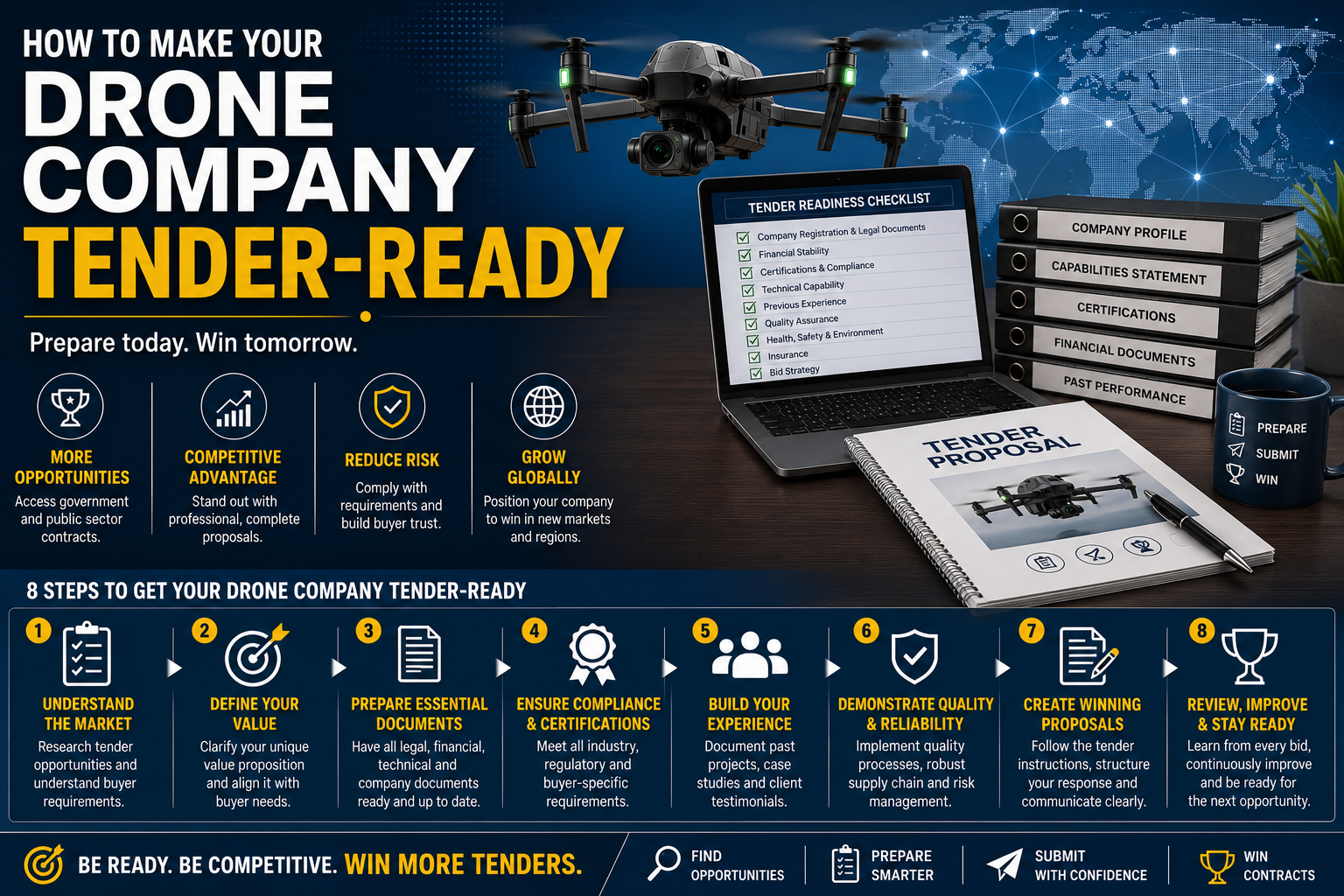
Becoming tender-ready means preparing the business before the opportunity arrives. It is about creating the documents, internal processes, approvals and technical information needed to respond quickly and professionally when the right tender appears.
At Global Drones, we help drone manufacturers identify relevant tender opportunities worldwide, qualify them and support the preparation and submission process. The more prepared a manufacturer is before a tender is published, the more efficiently that opportunity can be pursued.
Tender readiness does not mean creating hundreds of pages of generic material. It means making sure the core information customers repeatedly request is organised, current and approved.
Start With a Complete Company Information Pack
Most tenders require basic corporate information before the customer even begins evaluating the technology.
This may include company registration information, ownership details, financial information, insurance, tax documentation and organisational structure.
Manufacturers should keep this information together in one controlled location rather than searching for it every time a tender appears.
A basic company tender pack may include:
- Company registration documents
- Registered business address
- Company ownership information
- Tax and VAT information
- Banking details where appropriate
- Insurance certificates
- Organisation chart
- Contact information
- Company profile
- Financial statements where required
The objective is speed and consistency. If the same company information appears differently across multiple documents, that can create unnecessary questions for the procurement team.
Maintaining one approved source also reduces the risk of submitting outdated information.
Create a Professional Company Profile
A company profile is one of the most reusable pieces of tender content.
It should explain who the manufacturer is, what it produces, where it operates and why customers should consider it a credible supplier.
The profile should not read like generic marketing copy. It should provide useful evidence.
A strong company profile can cover the company’s history, manufacturing capability, technology expertise, international presence, customer sectors, quality standards and support structure.
If the company has significant experience in drone technology, explain it clearly.
If products are already operating with recognised customers, mention this where permitted.
The purpose is to help evaluators quickly understand that the manufacturer is a serious and capable organisation.
Organise Your Technical Documentation
Technical information is at the centre of most drone tenders.
Manufacturers should maintain detailed and current specifications for every system they intend to offer through procurement.
This needs to go beyond a marketing brochure.
Technical information may include:
- Aircraft dimensions
- Maximum take-off weight
- Payload capacity
- Flight endurance
- Operating range
- Communications range
- Maximum wind tolerance
- Operating temperature
- IP rating
- Navigation systems
- GNSS capabilities
- RTK or PPK capability
- Payload interfaces
- Communications security
- Ground control system
- Battery information
- Charging requirements
Different tenders will request information in different formats, but having reliable source data available allows the tender team to respond quickly.
Engineering should approve the source information so that sales or tender teams are never guessing.
Separate Marketing Claims From Tender Evidence
Marketing material is designed to attract attention. Tender documentation is designed to prove compliance.
These are not the same thing.
A website might say that a system provides “industry-leading endurance.” A tender evaluator will normally want the actual endurance figure, test conditions and possibly supporting evidence.
Likewise, saying that a drone operates in difficult weather conditions is less useful than specifying the tested wind speed, operating temperature and protection rating.
Manufacturers should therefore build an evidence library that supports important technical claims.
This could include test reports, certificates, technical drawings, performance data and relevant approvals.
The stronger the evidence, the easier it becomes to demonstrate compliance.
Keep Certifications Current
Certifications frequently become a bottleneck during tender preparation.
A manufacturer may know it possesses a particular certification, but finding the correct version can take time. Another certificate may have expired, creating unnecessary pressure close to the deadline.
Maintain a central certification register containing current copies and expiry dates.
Depending on the manufacturer and market, this may include:
- Quality-management certifications
- Environmental certifications
- Product certifications
- Radio or communications approvals
- Cybersecurity certifications
- Safety documentation
- Country-specific approvals
Not every tender will require the same documents, but knowing what is available makes opportunity qualification much easier.
The tender team can quickly determine whether the manufacturer satisfies mandatory requirements before investing significant time in the bid.
Prepare Your Cybersecurity Information
Cybersecurity is becoming increasingly important in professional drone procurement.
Drones can collect sensitive imagery, infrastructure data, mapping information and operational intelligence. Customers therefore want to understand how data and communications are protected.
Manufacturers should prepare accurate documentation covering areas such as:
- Communications encryption
- Data encryption
- User authentication
- Access controls
- Software updates
- Vulnerability management
- Cloud infrastructure
- Data storage location
- Component origin
- Security architecture
The level of detail required will vary by customer.
A university conducting environmental research may have different requirements from a defence or critical-infrastructure organisation.
However, preparing the core information in advance means the company is not trying to build its cybersecurity narrative from scratch during every procurement.
Document Your Warranty Clearly
Warranty terms are often surprisingly difficult for manufacturers to explain consistently.
Different salespeople may have slightly different understandings of what is covered, how long the warranty lasts and what happens when a product needs repair.
This creates risk during tenders.
The manufacturer should have a clearly approved warranty policy stating what is covered, the warranty duration, exclusions, return procedures, repair processes and responsibilities.
The tender team can then adapt this information to the customer’s requested format without creating new commitments accidentally.
If extended warranty options are available, these should also be documented.
Clear warranty information improves customer confidence and reduces internal confusion.
Build a Training Package
Training should be prepared before the tender appears.
Customers may want to know how many operators can be trained, how long training takes, where it is delivered and what material is provided.
A manufacturer should therefore maintain a structured training offering.
This can cover:
- Initial operator training
- Administrator training
- Maintenance training
- Online learning
- Refresher training
- Train-the-trainer programs
- User manuals
- Operational documentation
If training differs depending on product configuration, explain the options clearly.
A professional training package helps show that the manufacturer is delivering an operational capability rather than simply shipping hardware.
Prepare Your Support and Maintenance Model
Customers want confidence that support will still be available after the purchase.
Manufacturers should document how technical issues are handled and what the customer can expect.
This may include:
- Technical support channels
- Response times
- Escalation procedures
- Repair processes
- Spare-parts availability
- Software update procedures
- Remote support
- Maintenance options
- Local partner support
If support is provided directly by the manufacturer, make that clear.
If local partners are involved, define their role carefully so the customer understands who is responsible for each part of the service.
Build Strong Customer References
References are among the most valuable tender assets a manufacturer can develop.
A procurement evaluator wants evidence that the company has delivered successfully before.
Do not wait until a tender asks for references before trying to create them.
Document successful projects as they happen.
A strong reference can explain the customer type, operational requirement, technology supplied, implementation process and results achieved.
Where confidentiality permits, include measurable outcomes.
For example, explain how the technology reduced inspection time, increased coverage, improved safety or enabled a new operational capability.
Several well-documented references can significantly strengthen future submissions.
Develop Case Studies From Successful Deployments
A customer reference confirms that a project happened. A case study explains why it mattered.
Manufacturers should build a library of case studies around different applications.
Potential categories might include:
- Infrastructure inspection
- Public safety
- Search and rescue
- Mapping
- LiDAR
- Environmental monitoring
- Agriculture
- Security
- Utilities
- Research
This makes it easier to provide relevant evidence depending on the tender.
A utility customer is more likely to respond positively to an infrastructure-inspection reference than an unrelated marketing example.
The closer the reference is to the customer’s application, the more valuable it becomes.
Create Standard Tender Responses
Tender questions repeat more often than manufacturers expect.
Customers regularly ask about quality, training, support, company history, cybersecurity, sustainability and project management.
Instead of writing these answers from scratch, manufacturers should create an approved response library.
Standard content can include responses around:
- Company experience
- Quality management
- Training
- Technical support
- Warranty
- Cybersecurity
- Data protection
- Environmental responsibility
- Project management
- Risk management
- Delivery
These responses should not simply be copied into every proposal unchanged.
They should provide a strong starting point that can be adapted to the customer’s exact question.
This saves time while maintaining consistency.
Build a Product Compliance Library
One of the fastest ways to respond to tenders is to understand exactly what each product can and cannot do.
Manufacturers should maintain a structured internal compliance profile for each system.
This profile could include major criteria such as endurance, payload capacity, IP rating, operating temperature, communications, navigation, cybersecurity and certifications.
When a tender appears, the tender team can quickly compare requirements against the product.
This makes Bid/No-Bid decisions much faster.
It also exposes product gaps that may need to be addressed through future development.
Establish a Bid/No-Bid Process
Tender readiness is not only about documentation.
It is also about decision-making.
Manufacturers need a clear process for deciding which opportunities deserve resources.
A Bid/No-Bid decision should consider:
- Technical fit
- Commercial value
- Delivery feasibility
- Customer importance
- Competition
- Reference requirements
- Local requirements
- Probability of success
- Internal workload
Management should define who has authority to approve participation.
Without this process, sales teams may begin working on tenders that management later decides not to pursue.
A clear decision at the beginning saves substantial time.
Define Internal Responsibilities
Tender preparation can involve almost every department in the manufacturer.
If responsibilities are unclear, deadlines can be missed.
The company should define who is responsible for each type of information.
For example:
- Engineering – technical specifications
- Sales – commercial strategy
- Finance – pricing
- Operations – delivery
- Legal – contract review
- Management – final approval
- Tender team – overall coordination
This makes internal requests faster.
Instead of sending general emails asking everyone for information, the tender manager knows exactly who owns each section.
Create an Internal Tender Timeline
Do not use the customer’s submission deadline as your internal deadline.
The tender process should include earlier milestones for technical responses, pricing, legal review and final approval.
For example, if the tender closes on a Friday, the internal objective may be to have the complete submission approved by Wednesday.
This creates time to deal with portal problems, missing documents or final corrections.
A professional tender process should always include buffer time.
Know Who Can Approve Pricing
Pricing delays can become a major problem.
The tender team may prepare everything else but wait several days for final commercial approval.
Manufacturers should define who can approve pricing and at what level.
This can include discount authority, minimum margins and rules around special commercial conditions.
The tender team should also understand who can approve exceptions.
A clear pricing process makes submissions faster and reduces last-minute commercial uncertainty.
Prepare for Contract Review
Tender documents often include contract terms that the manufacturer will be expected to accept if successful.
These should not be ignored until after the award.
The company should know who reviews areas such as:
- Liability
- Penalties
- Intellectual property
- Payment terms
- Warranty
- Termination
- Insurance
- Data protection
- Delivery obligations
For significant projects, professional legal advice may be appropriate.
Winning a contract is only valuable if the resulting obligations are commercially manageable.
Make Sure Your Insurance Matches Your Target Market
Insurance requirements can vary considerably between tenders.
Manufacturers should understand what coverage they currently hold and whether it is sufficient for the types of contracts they intend to pursue.
Potential requirements may include product liability, public liability, professional indemnity or other specialist coverage depending on the work being performed.
Do not wait until the final week of the tender to discover that the customer requires coverage you do not have.
Keep current insurance certificates in the tender library and review likely procurement requirements periodically.
Prepare Financial Information
Larger contracts may require suppliers to demonstrate financial stability.
Customers may request financial statements, turnover information, banking details or evidence that the manufacturer is capable of supporting the contract.
This information should be prepared carefully and shared only where required.
The finance team should understand which documents can be provided and who needs to approve their release.
Having a process already established prevents delays during submission.
Understand Your Local Partner Strategy
International tenders may sometimes require or benefit from local participation.
Manufacturers should know in advance where they have:
- Distributors
- Resellers
- Commercial agents
- Service partners
- Training partners
- System integrators
Maintain information about what each partner can actually do.
A distributor may provide customer access but not technical support. Another may be capable of demonstrations and first-line maintenance.
Knowing this in advance makes it easier to build the right team around an opportunity.
Global Drones can also help coordinate opportunities with local partners where appropriate.
Maintain Accurate Product Pricing Structures
Tender pricing can be more complex than a standard quotation.
Customers may ask for separate pricing for systems, payloads, software, training, maintenance and options.
Manufacturers should maintain clear internal pricing structures covering the complete solution.
This can include:
- Aircraft
- Payloads
- Batteries
- Chargers
- Ground stations
- Software
- Training
- Maintenance
- Spare parts
- Warranty extensions
Clear internal pricing makes it easier to build accurate commercial schedules and avoid discrepancies between the technical and financial proposal.
Prepare Your Demonstration Process
Some tenders include product demonstrations or evaluation trials.
Manufacturers should be ready for this.
Define what systems are available for demonstrations, who operates them, how quickly they can be deployed and what travel or logistics may be involved.
Where possible, create standard demonstration scenarios around important applications.
A customer-focused demonstration can significantly strengthen the tender.
The objective is not simply to show that the drone flies. It is to demonstrate how the system solves the customer’s operational problem.
Use a Central Tender Document Library
All tender-ready information should be stored centrally.
A manufacturer should not depend on individual employees remembering where documents are located.
The library can be organised into areas such as:
- Corporate
- Technical
- Financial
- Certifications
- Insurance
- Legal
- Training
- Support
- Cybersecurity
- Case studies
- References
- Previous tenders
Version control is important.
The tender team needs confidence that it is always using the latest approved document.
Create an Expiry-Date System
Many tender documents have expiry dates.
Insurance certificates, quality certifications and other approvals need to remain current.
The manufacturer should track expiry dates and create reminders before documents become invalid.
This avoids discovering during a live tender that a critical certificate expired several weeks earlier.
Automation can make this process much easier.
Use Templates Without Making the Proposal Generic
Templates can save enormous amounts of time.
However, they should never replace customer-specific writing.
A tender-ready company should have templates for recurring sections such as:
- Executive summary
- Company profile
- Technical approach
- Training
- Support
- Warranty
- Project management
- Risk management
When a new opportunity appears, these templates provide structure.
The content must then be adapted to the customer’s exact requirements.
The best tender submissions feel specific even when much of the underlying information has been reused.
Use AI and Automation Carefully
AI can help accelerate certain elements of tender preparation.
For example, software can potentially help extract requirements, organise questions, create draft compliance matrices and identify relevant material from a manufacturer knowledge base.
It can also help produce first drafts based on approved information.
However, manufacturers should never allow automated systems to create unverified technical claims or contractual commitments.
All critical information must still be reviewed by qualified people.
Automation should remove repetitive work so the team can focus more attention on strategy, customer value and final quality.
Build a Tender Readiness Score
Manufacturers can assess their preparedness across several categories.
For example:
- Company information
- Technical documentation
- Certifications
- Insurance
- References
- Training
- Support
- Cybersecurity
- Pricing
- Legal readiness
Each area can be scored according to whether documents are complete, current and approved.
This provides a quick picture of weaknesses.
If technical documentation scores highly but references are weak, the company knows where to focus.
If cybersecurity information is incomplete, it can be addressed before an important government opportunity appears.
Tender readiness becomes measurable rather than subjective.
How Global Drones Can Help Manufacturers Become Tender-Ready
Global Drones supports manufacturers before and during the tender process.
Manufacturers joining our Manufacturer Program can provide structured information about their systems, capabilities, applications and target markets.
This gives us a foundation for identifying relevant opportunities and understanding which manufacturers fit particular requirements.
Global Drones can also support areas including:
- Tender identification
- Opportunity qualification
- Bid/No-Bid coordination
- Compliance management
- Tender preparation
- Document coordination
- Submission management
- Deadline tracking
- End-client communication
- Local partner coordination
The manufacturer remains responsible for technical approval, pricing, customer contracts, delivery, warranty and after-sales support.
The stronger the manufacturer’s tender readiness, the faster and more efficiently these opportunities can be pursued.
Tender Readiness Can Become a Competitive Advantage
Tender readiness is not simply an administrative exercise.
It can directly influence sales performance.
Two manufacturers may have similarly capable products, but one can respond within days while the other spends weeks gathering documents.
One provides clear references, certifications and support information immediately.
The other appears disorganised.
Procurement teams notice these differences.
A manufacturer that consistently produces clear, complete and professional submissions can reduce customer risk and build greater confidence.
This can become a genuine competitive advantage.
Prepare Before the Opportunity Arrives
The worst time to build your tender process is after discovering a major tender with a short deadline.
The best time is before you need it.
Organise your documents.
Prepare your standard answers.
Document successful projects.
Clarify internal responsibilities.
Create approval processes.
Keep certifications current.
Build your product compliance information.
Then, when the right opportunity appears, your team can focus on winning rather than searching for paperwork.
That is what being tender-ready really means.
Let Global Drones Help You Compete
Global Drones helps drone manufacturers, payload manufacturers, software companies and related technology providers identify and pursue international tender opportunities.
We help manufacturers find suitable opportunities, prepare submissions and manage the tender process while they remain responsible for their technology, pricing, customer contract, delivery and support.
If your company wants to pursue more government, infrastructure, utility, research or commercial procurement opportunities, the first step is making sure you are ready when those opportunities appear.
Join the Global Drones Manufacturer Program and turn tender readiness into international sales opportunity.
Be prepared before the tender is published, not after the deadline starts counting down.