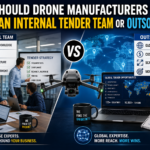
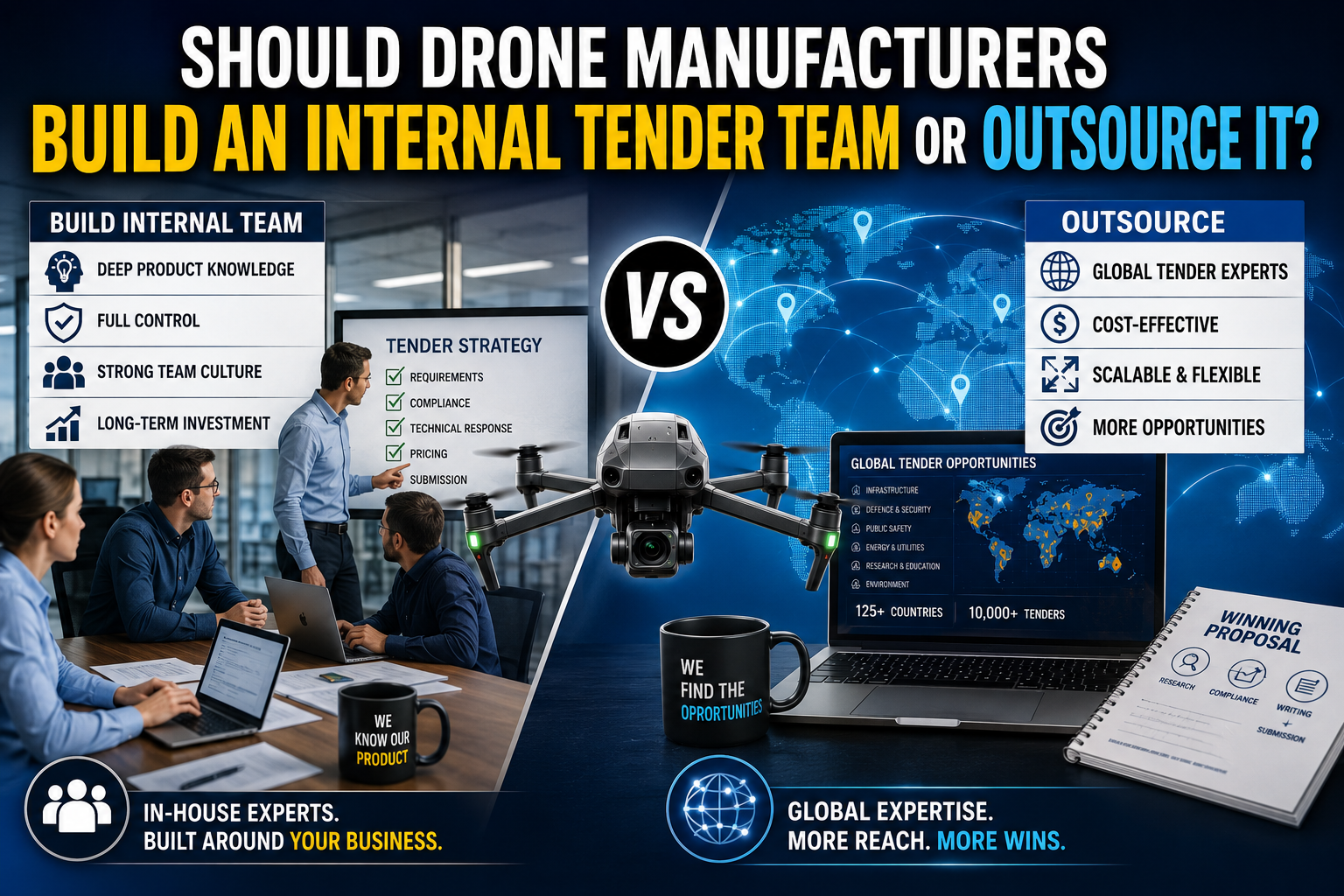
As public and private procurement becomes a more important route to market for drone manufacturers, a practical question quickly follows: should the company build its own internal tender team, or outsource some or all of the process to a specialist partner?
There is no single answer that works for every manufacturer. The right structure depends on the number of tenders being pursued, the size of the sales organisation, the complexity of the products, the number of target countries and how much internal expertise already exists.
For some manufacturers, a dedicated internal bid team will eventually make sense. For others, outsourcing tender discovery, qualification and bid coordination can provide a faster and more cost-effective route to international growth.
At Global Drones, we support drone manufacturers by identifying relevant tender opportunities worldwide, qualifying them against manufacturer capabilities, preparing and coordinating tender documentation and supporting engagement with end clients. The manufacturer remains responsible for its technology, pricing, customer contract, delivery, warranty and after-sales support.
The key is not whether tender management sits entirely inside or outside the business. The real question is how to build a tender process that gives the manufacturer enough opportunity coverage without creating unnecessary cost or administrative pressure.
What an Internal Tender Team Actually Needs to Do
A tender team does much more than write proposals.
Before a tender is ever submitted, someone has to identify the opportunity, review the procurement documentation, determine whether the manufacturer is eligible and decide whether the project is worth pursuing.
Once the decision to bid has been made, the workload increases. The team needs to coordinate technical information, gather company documents, manage compliance requirements, prepare pricing schedules, review contractual terms and make sure the final submission is completed correctly and on time.
An internal tender function may therefore be responsible for:
- Tender monitoring
- Opportunity qualification
- Bid/No-Bid coordination
- Compliance matrices
- Document collection
- Proposal writing
- Pricing coordination
- Internal approvals
- Submission management
- Clarification responses
- Demonstration coordination
- Win/loss analysis
For manufacturers bidding across several countries, the team may also need to understand different procurement systems, submission platforms and local requirements.
What initially looks like one administrative role can quickly become a substantial commercial function.
The Advantages of Building an Internal Tender Team
The strongest argument for an internal team is control.
Employees inside the manufacturer can develop a deep understanding of the company’s products, strategy, customers and commercial priorities. Over time, they become familiar with technical capabilities, recurring tender questions and internal approval processes.
This can make bid preparation more efficient.
An experienced internal tender manager also develops close relationships with engineering, sales, finance, operations and management. Instead of repeatedly explaining how the company works to an external partner, the tender team becomes part of the normal commercial organisation.
Another advantage is knowledge retention.
Every tender creates information. The company learns what customers request, which competitors appear regularly, which requirements are difficult to satisfy and which sections of its proposals score well.
Keeping the team internally means much of that knowledge remains within the organisation.
For manufacturers pursuing a large number of tenders every year, these benefits can become significant.
An Internal Team Can Build Deep Product Knowledge
Drone systems can be technically complex.
A manufacturer may offer several aircraft, payload configurations, software options and communications systems. Different customers may require different combinations.
An internal tender specialist working with the company every day can gradually understand these products in considerable detail.
That knowledge helps when reviewing requirements.
The tender manager may quickly recognise that one platform satisfies a particular endurance requirement while another does not. They may know which payload integrations are already tested and which require engineering work.
This can make opportunity qualification faster and improve the quality of the response.
However, product knowledge alone is not enough. Tender teams also need to understand procurement processes, commercial risk and proposal management.
The Biggest Disadvantage of an Internal Team Is Cost
Building a capable tender department creates fixed overhead.
The manufacturer may need to employ a tender manager, bid writer or additional commercial support before knowing exactly how many opportunities will be pursued.
If the company submits only a small number of bids each year, those employees may not be fully utilised.
The total cost goes beyond salary.
An internal team can involve:
- Salaries
- Employer costs
- Recruitment
- Training
- Software
- Tender databases
- Management time
- Travel
- Local specialist support
For a smaller drone manufacturer, this can represent a significant investment.
A company may want global tender coverage but simply not have enough volume yet to justify several full-time employees.
This is where outsourcing can become attractive.
Internal Teams Can Still Struggle With Global Tender Discovery
Even a capable bid writer cannot submit opportunities the company never finds.
Global tender discovery is a separate challenge.
Relevant procurement opportunities may appear across national portals, regional authorities, utilities, universities, defence organisations and private procurement platforms.
They may also be published using terminology that does not obviously refer to drones.
A tender might request an aerial inspection platform, remote sensing solution, autonomous monitoring capability or unmanned survey system.
Monitoring these sources across multiple countries takes time.
An internal tender team may become so focused on preparing active submissions that it has limited capacity left for global opportunity discovery.
This can create a situation where the manufacturer has strong bid capability but weak market coverage.
The Advantages of Outsourcing Tender Management
Outsourcing allows manufacturers to access specialist tender capability without immediately building a permanent internal department.
This is particularly useful for companies that want to increase international coverage quickly.
An outsourced partner can potentially support:
- Global opportunity discovery
- Tender qualification
- Bid coordination
- Document preparation
- Compliance management
- Deadline tracking
- Submission support
The manufacturer can then concentrate internal resources on the areas where its expertise is essential.
Engineering provides technical information.
Sales approves commercial strategy.
Finance confirms pricing.
Management approves contractual commitments.
The outsourced tender team coordinates the process around them.
This can create a much more scalable model for manufacturers that are still growing their international sales organisation.
Outsourcing Converts Fixed Cost Into Variable Cost
One of the strongest commercial arguments for outsourcing is flexibility.
Instead of hiring several people before tender volume is proven, the manufacturer can use external support when opportunities arise.
This can be particularly attractive for companies experiencing uneven tender activity.
There may be several major opportunities in one month and very little activity the next.
An outsourced model can provide additional capacity during busy periods without creating the same permanent cost base.
Depending on the commercial arrangement, manufacturers may pay through:
- Project fees
- Monthly retainers
- Day rates
- Success fees
- Commission
- Combination models
The best structure depends on how much support is being provided.
For manufacturers entering public procurement for the first time, outsourcing can also provide a way to test the opportunity before investing in a permanent team.
Outsourcing Can Expand International Coverage
A manufacturer may have excellent internal sales capability but limited knowledge of procurement outside its home country.
A specialist tender partner can broaden that reach.
At Global Drones, the focus is international opportunity identification rather than waiting for manufacturers to discover tenders themselves.
Manufacturers joining our Manufacturer Program provide information about their products, applications and target markets. This allows relevant opportunities to be matched more effectively.
The benefit is not simply administrative support.
It is increased visibility into the market.
A manufacturer may discover tenders from customers, countries and industries that its existing sales team would never normally encounter.
That can make outsourced tender management part of a broader international market-access strategy.
Outsourced Teams Can Bring Process Discipline
Manufacturers sometimes handle tenders informally.
A salesperson finds an opportunity and begins sending emails internally asking for documents. Engineering provides information when available. Pricing is developed late. The submission comes together just before the deadline.
This may work for occasional simple tenders, but it becomes risky as volume increases.
A specialist tender team can introduce a more structured process.
That may include:
- Initial qualification
- Bid/No-Bid review
- Compliance matrix
- Responsibility assignment
- Internal milestones
- Technical review
- Commercial review
- Final approval
- Submission confirmation
This structure reduces the risk of important requirements being missed.
It also helps manufacturers understand exactly where an opportunity sits within the tender lifecycle.
The Main Risk of Outsourcing Is Losing Product Context
Outsourcing is not automatically better.
The largest weakness is that an external team does not live inside the manufacturer’s business every day.
If the relationship is poorly structured, the outsourced writer may not fully understand the technology.
That can lead to generic proposals, incorrect assumptions or excessive dependence on marketing material.
The solution is not to exclude the manufacturer from the process.
The strongest outsourced model is collaborative.
The external tender team manages the process, while the manufacturer remains responsible for technical accuracy and commercial approval.
This division is particularly important in the drone industry because claims relating to endurance, communications range, autonomy, payload capacity and environmental performance must be accurate.
The tender partner should never invent technical answers.
Outsourcing Should Not Mean Outsourcing the Customer Relationship
Another concern manufacturers may have is losing visibility into the end client.
That should not happen.
The tender partner can support opportunity discovery and bid management, but the manufacturer should remain involved in important customer conversations.
When the procurement process requires a technical meeting, demonstration or commercial discussion, the manufacturer should participate directly.
For the Global Drones model, this is a core principle.
Global Drones can identify and support the opportunity, but the manufacturer remains responsible for:
- Technical discussions
- Demonstrations
- Pricing
- Quotations
- Contract negotiation
- Contract signing
- Delivery
- Training
- Warranty
- After-sales support
This preserves the manufacturer’s relationship with the customer while reducing the tender workload.
A Hybrid Model Is Often the Best Solution
For many manufacturers, the best answer is neither fully internal nor fully outsourced.
A hybrid model can combine the strengths of both.
The manufacturer keeps internal ownership of product knowledge, pricing, commercial strategy and customer relationships.
An external partner supports opportunity discovery, tender management and administrative coordination.
For example:
Global Drones could handle:
- Global tender discovery
- Initial opportunity qualification
- Compliance coordination
- Document management
- Bid preparation
- Deadline management
- Submission support
The manufacturer could handle:
- Technical approval
- Product configuration
- Pricing
- Legal approval
- Demonstrations
- Contract negotiation
- Delivery
- Support
This structure can work particularly well for small and medium-sized drone manufacturers.
It gives them professional tender capability without requiring a large permanent bid department.
When an Internal Tender Team Makes More Sense
There are situations where internalising the function becomes the better option.
A manufacturer may reach a point where it is pursuing a large number of significant tenders every month. The volume of work becomes predictable and justifies dedicated employees.
An internal team may also be preferable when procurement involves highly sensitive information, complex defence requirements or extensive customer-specific technical development.
Building internally may make sense when:
- Tender volume is consistently high
- Contracts are strategically important
- The company has enough revenue to support a permanent team
- Product complexity requires deep daily technical knowledge
- Internal security requirements limit external involvement
- Government procurement is a core sales channel
Even in these cases, the manufacturer may still use external partners for international opportunity discovery or specialist local support.
When Outsourcing Makes More Sense
Outsourcing is often more attractive earlier in the company’s tender journey.
A manufacturer may know that procurement represents a significant opportunity but have insufficient volume to justify a permanent team.
Outsourcing can also be useful when the manufacturer wants to expand rapidly into several countries.
It may make sense when:
- The manufacturer has a small sales team
- Tender activity is inconsistent
- Global market coverage is limited
- There is no internal bid specialist
- Salespeople are already overloaded
- The company wants to test tender-led growth
- International expansion is a priority
In these situations, outsourcing can provide immediate capability while the manufacturer learns how important tenders may become to future revenue.
Compare the True Cost, Not Just Salary
Manufacturers considering internal versus outsourced tender management should compare total cost rather than simply comparing an employee salary with an external fee.
Internal cost can include recruitment, benefits, software, management, training and periods when tender volume is low.
Outsourced cost should include not only the provider fee but also the internal time required to supply information and approve submissions.
The decision should therefore consider:
- Annual tender volume
- Average contract value
- Win rate
- Internal staff cost
- External support cost
- Opportunity coverage
- Speed of response
- Strategic importance
The right solution is the one that produces the strongest commercial return while maintaining proposal quality.
Measure Tender Performance
Regardless of whether the function is internal or outsourced, manufacturers should measure results.
Useful metrics can include:
- Opportunities identified
- Opportunities qualified
- Bids submitted
- Bid value
- Win rate
- Average contract value
- Time spent per tender
- Cost per bid
- Revenue generated
- Reasons for losses
These metrics help management determine whether the tender strategy is working.
They also make it easier to decide when an outsourced model should evolve into an internal team or when an internal team needs additional external capacity.
Build a Central Tender Knowledge Base
One requirement applies to both models: information needs to be organised.
Whether tenders are handled internally or externally, the manufacturer should maintain a central library of approved documentation.
This can include:
- Company information
- Product datasheets
- Technical specifications
- Certifications
- Insurance documentation
- Warranty information
- Training material
- Cybersecurity documentation
- Quality policies
- Environmental policies
- Customer references
- Case studies
- Standard tender responses
This knowledge base significantly reduces the amount of work required for every new submission.
It also ensures that external partners work from approved information rather than creating answers independently.
Use Technology to Reduce Workload
Tender software can make both internal and outsourced models more efficient.
A good system should track opportunities from discovery through award.
It can also help manage:
- Tender deadlines
- Assigned responsibilities
- Compliance requirements
- Manufacturer documents
- Standard responses
- Approval stages
- Submission status
- Customer clarifications
- Win/loss data
AI can also assist with parts of the process, including requirement extraction, draft compliance matrices and first-draft responses.
However, AI should support rather than replace human review.
Technical specifications, pricing and contractual commitments must always be verified before submission.
How Global Drones Fits Into the Model
Global Drones is designed to operate as an outsourced tender and market-access capability for drone manufacturers and related technology companies.
Our Manufacturer Program allows us to understand each manufacturer’s technology, applications and target markets.
From there, Global Drones can support areas such as:
- Global tender identification
- Opportunity matching
- Initial qualification
- Bid/No-Bid coordination
- Compliance management
- Tender preparation
- Document coordination
- Submission support
- Deadline management
- End-client coordination
The manufacturer remains responsible for its core commercial and technical responsibilities.
That includes technical approval, pricing, quotations, contracts, product delivery, warranty and after-sales support.
This allows the manufacturer to gain additional tender capacity without handing over control of the sale.
Start Outsourced and Build Internally as Volume Grows
For many growing drone manufacturers, a sensible strategy is to begin with external tender support and gradually build internal capability as the opportunity volume increases.
This reduces initial fixed costs.
It also allows the manufacturer to understand which parts of the process genuinely require internal employees.
For example, after two years the company may decide that it needs an internal tender manager because government procurement has become a major revenue channel. Global Drones could then continue supporting international tender discovery and additional bid capacity.
The model can evolve with the business.
Outsourcing does not need to be permanent, and internalisation does not mean external support becomes unnecessary.
The objective is flexibility.
The Best Tender Team Is the One That Creates More Winning Opportunities
The internal-versus-outsourced debate can become too focused on organisational structure.
The real measure should be commercial performance.
Does the manufacturer see enough relevant opportunities?
Are the right tenders being selected?
Are submissions being prepared professionally?
Are deadlines being met?
Are win rates improving?
Are government and enterprise customers becoming a meaningful source of revenue?
If the answer is yes, the structure is working.
For some manufacturers, that will mean a dedicated internal tender department. For others, it will mean outsourcing most of the process. For many, the strongest solution will be a combination of both.
Global Drones Can Become an Extension of Your Sales Team
Global Drones helps drone manufacturers, payload manufacturers, software providers and related technology companies increase their visibility into international procurement opportunities without requiring them to immediately build large internal tender teams.
We help find suitable tenders, qualify opportunities, prepare and coordinate submissions and support engagement with end clients as the procurement progresses.
The manufacturer retains ownership of the technology, pricing, contracts, delivery and customer support.
This creates a straightforward model: Global Drones extends the manufacturer’s international tender capability while the manufacturer continues to do what it does best.
If your company wants to pursue more global tenders but does not yet want the cost and complexity of building a full internal bid department, join the Global Drones Manufacturer Program.
You don’t necessarily need a bigger sales team. You may simply need greater opportunity coverage and a better tender process.