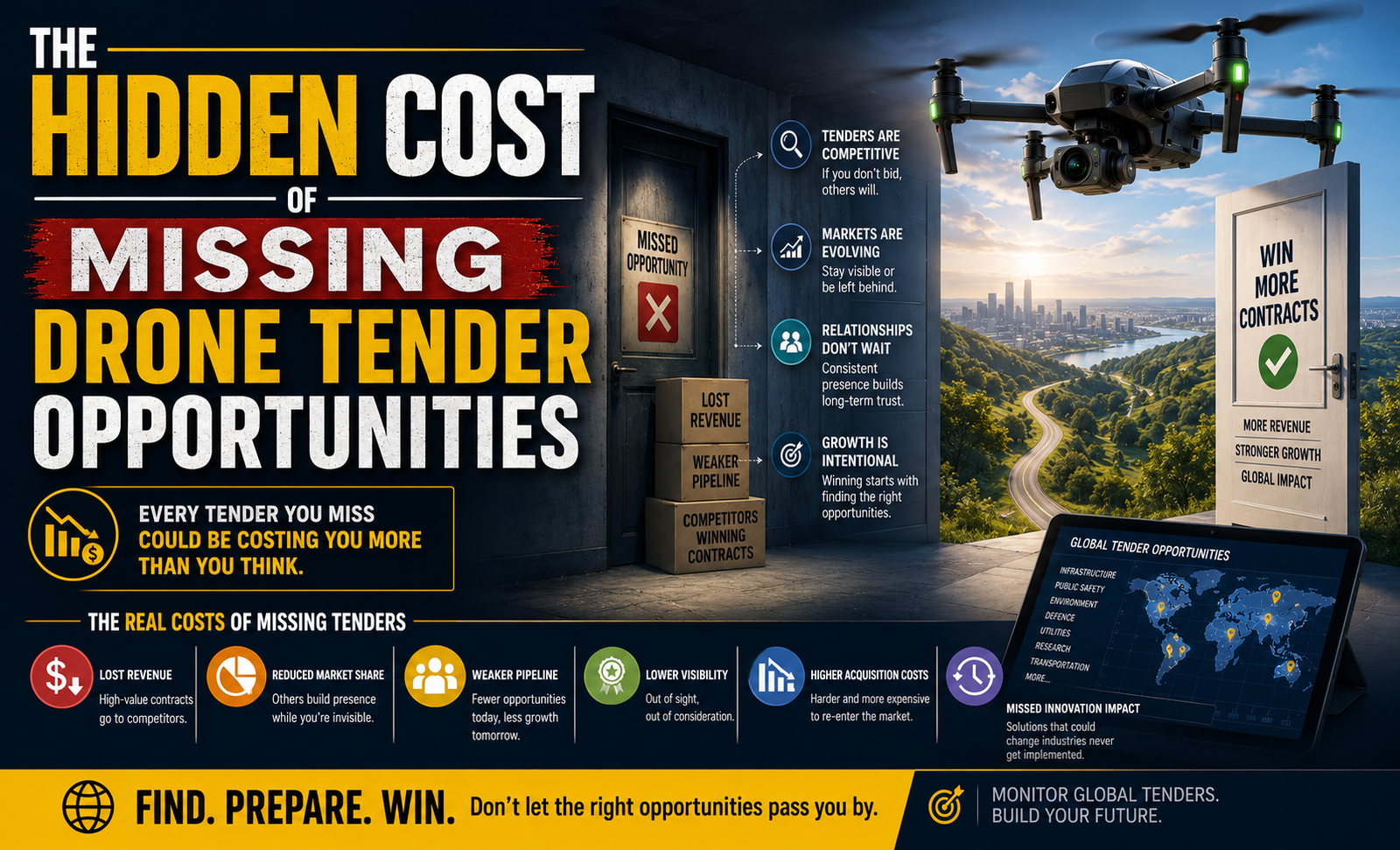
For drone manufacturers, the cost of missing a tender is not always obvious. If a sales team never sees an opportunity, there is no rejected proposal, no lost negotiation and no failed bid to review. The tender is published, another supplier responds, the contract is awarded and the manufacturer may never know the opportunity existed.
That is what makes missed tenders so commercially dangerous. A manufacturer can spend heavily on product development, exhibitions, certifications, distributor recruitment and international marketing while still overlooking customers that are already actively looking to buy exactly the type of technology it produces.
The hidden cost is also much larger than the value of one missed order. A lost tender can mean losing future follow-on purchases, a valuable reference customer, entry into a new country, visibility into market demand and the chance to build a relationship with an organisation that may buy repeatedly over many years.
At Global Drones, we help drone manufacturers, payload manufacturers, software companies and related technology providers identify relevant tender opportunities worldwide, qualify them, prepare and coordinate submissions and support engagement with end clients. The aim is simple: help manufacturers avoid missing strong opportunities simply because they were not monitoring the right procurement channels.
A Missed Tender Is Often a Missed Qualified Sales Opportunity
Traditional lead generation can be uncertain. A sales team may spend weeks or months contacting organisations that appear suitable but do not yet have an approved project, budget or immediate purchasing requirement. Interest does not always mean intent to buy.
A tender is different because the customer has usually progressed further in the buying process. The organisation has identified a need and has started a structured procurement process. It may already have technical requirements, quantities, delivery expectations, evaluation criteria and an internal budget framework.
That means a tender is often much more valuable than a normal cold sales lead. The customer is not simply researching the market. It is actively looking for suppliers that can meet a defined requirement.
When a manufacturer never sees that tender, it misses the chance to compete for a customer that has already entered the buying process. For any company trying to grow internationally, that is a significant lost opportunity.
The Most Expensive Opportunities Are Often the Ones You Never Knew Existed
Sales teams normally analyse deals they lose. They can review pricing, competition, product fit, customer relationships and technical requirements. Even a lost deal can provide useful information.
Missed tenders provide no such learning.
The manufacturer never enters the competition, so there is nothing to analyse internally. Another supplier wins the project, builds the relationship and gains the customer reference, while the manufacturer may continue believing there is little demand in that market.
This can create a dangerous blind spot. A company might assume that a country or sector is weak because few enquiries are coming through its existing channels. In reality, those customers may be buying through procurement systems that nobody inside the company is monitoring.
Tender monitoring therefore helps distinguish between a market with low demand and a market where demand simply is not visible to the manufacturer.
The Direct Revenue Loss Can Be Significant
The most obvious cost of missing a tender is the contract itself.
Drone procurement can range from relatively small purchases to major projects involving multiple aircraft, payloads, software, training, maintenance and support. Missing one suitable contract could therefore mean losing tens of thousands, hundreds of thousands or potentially millions in revenue.
However, the initial contract value often tells only part of the story.
A customer that purchases a small fleet may later require additional systems, replacement aircraft, new payloads, software subscriptions, batteries, training or maintenance. If the technology becomes embedded within the organisation, future purchases may follow naturally.
Potential follow-on revenue can include:
- Additional drones
- Additional payloads
- Batteries and spare parts
- Ground control equipment
- Software licences
- Training
- Maintenance contracts
- Extended warranties
- Replacement systems
- Technology upgrades
When the full lifetime value of the customer is considered, the commercial cost of missing the original opportunity can be far larger than the headline tender value.
Missing the First Contract Can Mean Losing the Customer for Years
Professional drone customers often invest more than money when they choose a system. They train staff, create operating procedures, integrate software, develop maintenance processes and build internal experience around the selected platform.
Once that happens, changing supplier can become difficult.
This creates an incumbent advantage.
If a competitor wins the first tender, it may become the natural supplier for future expansion. The customer may prefer compatible aircraft, payloads and software rather than introducing a completely different ecosystem.
The competitor also gains direct relationships with users, managers, procurement teams and technical decision-makers.
This means a missed tender today may influence procurement decisions several years into the future. The manufacturer has not only lost one order. It may have lost the chance to become embedded within an important account.
The Lost Reference Can Be Almost as Valuable as the Lost Revenue
Reference customers matter greatly in public-sector and enterprise procurement.
Many tenders ask manufacturers to demonstrate previous experience with similar customers, projects or operational environments. Buyers want reassurance that the supplier has successfully delivered comparable technology before.
A strong government, utility, university, emergency-services or infrastructure reference can therefore help reduce perceived procurement risk.
Missing one tender also means missing the chance to build that reference.
This can create a compounding disadvantage. A competitor that wins several public-sector projects can use those deployments as evidence in future bids. The manufacturer that never saw those opportunities may continue competing without the same level of proof.
Over time, tender wins build credibility.
A recognised customer can support:
- Future government tenders
- Distributor discussions
- New market entry
- Sales presentations
- Case studies
- Investor conversations
- Strategic partnerships
The value of the reference can therefore extend far beyond the original sale.
Every Competitor Win Can Make Future Competitions Harder
When a competitor wins a tender, it gains more than revenue.
It also gains operational experience, customer feedback, references, deployment data and additional credibility. It learns more about how procurement teams evaluate drone technology and which parts of its tender response perform well.
That makes the competitor stronger.
A manufacturer that repeatedly misses procurement opportunities may find itself falling behind even if its technology remains technically competitive.
This is why tender intelligence is partly defensive as well as offensive.
Manufacturers need to know where significant customers are buying so they have the option to compete rather than allowing competitors to build market position uncontested.
Missed Tenders Can Distort Your View of Market Demand
Manufacturers often judge market demand based on direct enquiries, distributor activity, exhibition leads and conversations with existing customers.
These sources are useful, but they do not show the complete market.
Public procurement may represent a significant share of purchasing activity in sectors such as emergency services, utilities, infrastructure, defence, research and environmental monitoring.
If that activity is not being monitored, management may draw the wrong conclusions.
A manufacturer might assume there is limited demand for its technology in a particular country because its sales team receives few enquiries. At the same time, utilities and public authorities in that market could be publishing relevant procurement opportunities regularly.
The issue is not demand. It is visibility.
Monitoring tender activity can help management understand:
- Which countries are actively purchasing
- Which industries are investing
- Which applications are growing
- Which technical requirements are becoming common
- Which customers are entering procurement
This information can materially improve international sales planning.
Missed Tender Intelligence Can Lead to Poor Market-Entry Decisions
Entering a new market costs money.
Manufacturers may need distributors, local representatives, translated material, demonstrations, exhibitions, certifications and regulatory support.
Without procurement intelligence, it can be difficult to know which markets justify that investment.
Tender activity provides evidence of actual purchasing demand.
If one country consistently generates relevant opportunities while another generates very few, management can use that information when deciding where to focus.
Missing those tenders therefore means losing both sales opportunities and strategic intelligence.
The manufacturer could spend heavily developing a market with limited procurement activity while ignoring another country where customers are actively buying its type of technology.
A good tender-monitoring process can help commercial investment follow real opportunity.
Your Distributor Network Will Not Always Find Everything
Manufacturers frequently assume that local distributors will identify important tenders in their territories.
Some will, but it is risky to depend entirely on that assumption.
A distributor may have strong relationships in one vertical market but little visibility in another. It may be excellent with commercial customers but less experienced with government procurement. It may also represent many product lines and have limited time to monitor every relevant portal.
This does not necessarily make the distributor a poor partner. Tender monitoring itself can be a specialist activity.
A stronger approach is to supplement local channel activity with central tender intelligence.
If Global Drones identifies a suitable opportunity in a distributor’s territory, the manufacturer can involve that partner where appropriate. The distributor then receives a qualified opportunity rather than carrying the entire responsibility for opportunity discovery.
This can strengthen the channel while giving the manufacturer greater visibility.
Discovering the Tender Too Late Can Be Almost as Expensive as Missing It Completely
There is another form of missed opportunity that is less obvious.
The manufacturer finds the tender, but only a few days before the deadline.
Technically, it may still be possible to submit. In practice, the company may not have enough time to prepare a competitive response.
Engineering is asked for technical information urgently. Finance has to develop pricing quickly. Management has little time to review contract terms. Customer references are collected at the last minute and supporting documents may be difficult to locate.
The company submits something, but the proposal is weaker than it should have been.
Early discovery gives manufacturers time to carry out the tender properly.
That includes:
- Reviewing requirements
- Making a Bid/No-Bid decision
- Asking clarification questions
- Finding local support if needed
- Building a compliance matrix
- Collecting documents
- Preparing pricing
- Reviewing contract terms
- Obtaining internal approvals
In tender management, time directly affects quality.
Finding the right opportunity early can therefore be an important competitive advantage.
Missing Tenders Also Means Missing Product Intelligence
Tender documents can provide extremely detailed information about what professional customers expect from drone technology.
If manufacturers are not monitoring procurement, they also miss this intelligence.
Across multiple tenders, patterns may begin to appear around requirements such as:
- Flight endurance
- Payload capacity
- Weather resistance
- Cybersecurity
- Communications security
- Autonomous operation
- AI capabilities
- RTK and PPK
- LiDAR integration
- Thermal imaging
- Local support
- Training
- Warranty periods
One requirement may be customer-specific. Repeated requirements across several markets can indicate an important trend.
Manufacturers that see these patterns early can respond through product development, partnerships, certification or marketing.
Those that do not may discover the trend only after losing multiple sales opportunities.
Tender monitoring therefore provides value to engineering and product teams as well as sales.
The Hidden Cost of Not Being Tender-Ready
Finding the right opportunity is only useful if the manufacturer can respond effectively.
A company may discover an excellent tender but realise that important documents are missing or difficult to find.
Technical specifications may be scattered across departments. Insurance certificates may be outdated. Customer references may never have been formally documented. Cybersecurity responses may need to be created from scratch.
The tender team then spends most of the available time collecting standard information rather than developing a strong proposal.
Manufacturers pursuing public procurement should therefore maintain a tender-ready document library containing materials such as:
- Company information
- Product datasheets
- Technical specifications
- Certifications
- Insurance documentation
- Warranty information
- Training material
- Cybersecurity documentation
- Quality policies
- Environmental policies
- Customer references
- Case studies
- Standard tender responses
This preparation does not guarantee a win, but it makes it much easier to respond quickly when a strong opportunity appears.
The Cost of Pursuing the Wrong Tenders
There is also another side to the problem.
Finding more tenders does not mean manufacturers should bid for everything.
Tender preparation consumes engineering time, sales resources, management attention and often legal or financial support. Pursuing opportunities with little chance of success can become expensive.
This is why tender discovery must be combined with qualification.
Before committing resources, manufacturers should assess:
- Technical compliance
- Commercial value
- Delivery feasibility
- Eligibility
- Local requirements
- Customer fit
- Competitive position
- Reference requirements
- Probability of success
A strong tender strategy is not about having the largest possible number of bids.
It is about having visibility into a broad range of opportunities and then selecting the right ones.
That distinction is central to the Global Drones approach.
Measure the Opportunity You Are Currently Missing
One way manufacturers can understand the scale of the issue is to begin tracking tender intelligence systematically.
Useful metrics can include:
- Relevant tenders identified
- Total estimated contract value
- Opportunities qualified
- Opportunities pursued
- Opportunities discovered too late
- Tenders won
- Tenders lost
- Opportunities rejected due to missing requirements
After twelve months, the data can become extremely useful.
A manufacturer may discover that procurement opportunities worth many millions were published across its target markets during the year.
The company would never expect to win all of them, but even pursuing a small percentage could create a meaningful additional sales pipeline.
Without monitoring, that potential remains invisible.
Build a Tender Pipeline Rather Than a Tender List
A large spreadsheet containing procurement notices does not create sales.
Opportunities need to move through a structured process.
A typical tender pipeline may look like:
Tender Identified → Qualified → Bid/No-Bid → Proposal Preparation → Submitted → Evaluation → Demonstration → Negotiation → Won or Lost
Each opportunity should have an owner, estimated value, deadline, status and next action.
This transforms procurement intelligence into sales pipeline management.
Management can then see which opportunities are active, where internal resources are required and which tenders are moving closer to potential revenue.
How Global Drones Helps Manufacturers Avoid Missing Opportunities
Global Drones is building a dedicated tender and market-access service for drone manufacturers, payload manufacturers, software companies and related technology providers.
Manufacturers joining our Manufacturer Program provide information about their technology, applications, target markets and capabilities. This allows us to search for opportunities that are relevant to individual companies rather than simply producing large generic lists.
Global Drones can support manufacturers through:
- Global tender identification
- Opportunity matching
- Initial qualification
- Bid/No-Bid coordination
- Tender preparation
- Document management
- Submission coordination
- Deadline management
- End-client communication
- Opportunity tracking
When an opportunity progresses, the manufacturer remains responsible for the core commercial relationship.
The manufacturer controls its technical information, pricing, quotations, customer contract, delivery, warranty and after-sales support.
Our role is to extend its opportunity coverage and help manage the tender process.
The Manufacturer Remains in Control of the Sale
The Global Drones model is designed to generate and support opportunities rather than become the final supplier.
When an end client requires detailed technical information, a demonstration or commercial discussion, we can help connect the customer directly with the manufacturer.
If the opportunity is successful, the manufacturer can enter the commercial agreement, supply the technology and provide the required support.
This approach gives manufacturers additional international tender capability without forcing them to give up ownership of their customer relationships.
It also means the manufacturer remains clearly positioned as the technology provider while Global Drones operates as the tender and market-access partner.
The Real Cost of Missing Tenders Is Lost Growth
One missed tender may mean one lost order.
Repeatedly missing opportunities can have a much larger effect.
The manufacturer may lose customer relationships, market visibility, valuable references, future upgrades and insight into where demand is developing. At the same time, competitors continue to accumulate contracts, experience and credibility.
Over several years, the difference can become significant.
This is why procurement monitoring should be treated as part of a professional international sales infrastructure.
Manufacturers already invest in CRM systems to ensure leads are not lost. They develop distribution networks to improve market coverage. They attend exhibitions to find customers and create partnerships to open new industries.
Tender monitoring serves a similar purpose. It helps ensure that when a customer somewhere in the world publicly announces that it wants technology like yours, your company has the opportunity to evaluate that project.
Make Sure the Decision to Bid Is Yours
The objective is not to submit a proposal for every tender.
It is to make sure that the manufacturer gets to make the decision.
If a police organisation publishes a requirement that matches your technology, you should know about it.
If a utility needs an inspection platform that your aircraft can provide, you should have the opportunity to evaluate it.
If a university requires a LiDAR-equipped UAV matching your system, the requirement should reach your commercial team while there is still time to respond properly.
Once the opportunity is visible, management can decide whether it is technically, strategically and commercially worthwhile.
Without that visibility, the decision has effectively already been made.
The opportunity goes to someone else.
Let Global Drones Help You Find the Opportunities
Global Drones helps drone manufacturers and related technology companies identify relevant procurement opportunities worldwide, qualify them and support the tender process from discovery through submission and end-client engagement.
We help manufacturers increase their visibility into public and private tender opportunities without requiring them to build a large global tender-monitoring team internally.
The manufacturer remains responsible for its technology, pricing, contracts, delivery, warranty and customer support. Global Drones focuses on finding and managing the opportunities capable of generating new business.
If your company manufactures drones, payloads, sensors, software or related technologies and wants greater visibility into global procurement, join the Global Drones Manufacturer Program.
The biggest cost is not always losing a tender.
Sometimes, it is never knowing that you had the chance to win it.