For drone manufacturers, a tender can represent much more than a single sales opportunity. It can open the door to a new government customer, create a reference project in a new country, generate follow-on orders and strengthen the company’s position in future procurement competitions.
The challenge is that winning a tender requires a structured process. Finding the opportunity is only the first step. The manufacturer still needs to decide whether the project is worth pursuing, demonstrate compliance, prepare the required documents, submit the proposal correctly and support the customer through evaluation and contract award.
For manufacturers that do not have a dedicated internal bid team, this process can become time-consuming very quickly. Sales, engineering, finance, operations and management may all need to contribute, often while continuing to manage their normal responsibilities.
At Global Drones, we help drone and technology manufacturers identify relevant tender opportunities worldwide, qualify them, prepare and coordinate submissions and support engagement with end clients as opportunities progress. The manufacturer remains responsible for its technology, pricing, customer contract, delivery, warranty and after-sales support, while Global Drones helps manage the tender opportunity.
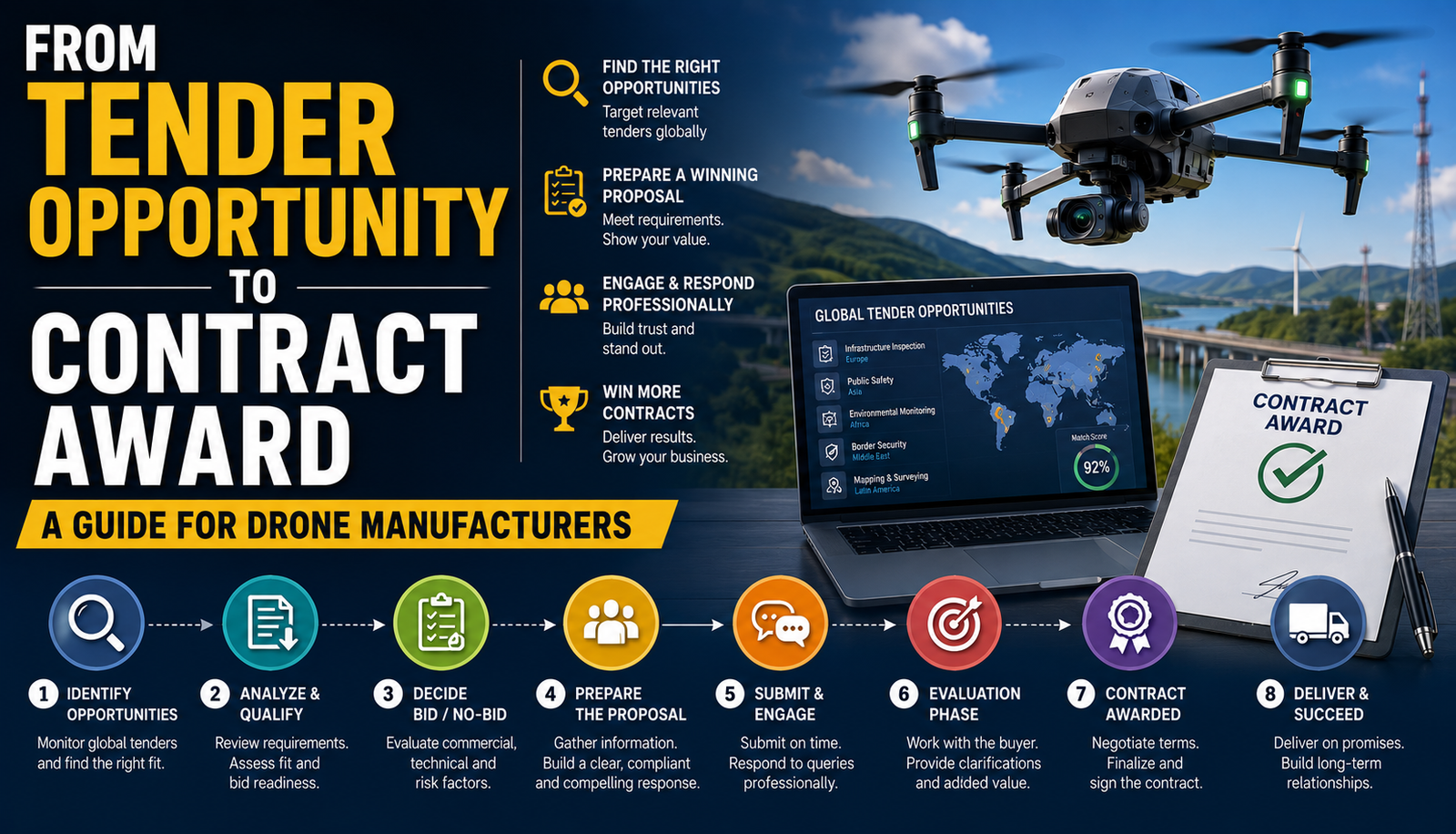
This guide explains the complete journey from discovering a tender through to contract award.
Stage 1: Identify the Right Tender Opportunity
The tender process starts with discovery.
Government organisations, utilities, emergency services, universities, infrastructure operators and commercial organisations publish procurement opportunities across a wide range of platforms. A manufacturer relying only on its existing distributors or direct sales team may never see many of these opportunities.
Relevant tenders can come from:
- Police and emergency services
- Defence and security organisations
- Electricity and utility operators
- Water authorities
- Rail infrastructure companies
- Ports and airports
- Universities and research institutions
- Environmental agencies
- Forestry organisations
- Municipal authorities
- Surveying organisations
- Public infrastructure operators
The procurement notice may not always use the word “drone.” Customers may describe their requirements as an aerial inspection system, remote sensing platform, unmanned survey solution, autonomous monitoring system or aerial LiDAR capability.
Effective tender monitoring therefore requires an understanding of applications as well as products.
At Global Drones, our role begins with identifying these opportunities and matching them against the capabilities of participating manufacturers.
Stage 2: Carry Out an Initial Qualification
Finding a tender does not mean the manufacturer should automatically bid.
Tender preparation can require significant time and resources, so the opportunity should first be qualified.
The objective is to establish whether the manufacturer has a realistic chance of winning.
The first review should consider technical, commercial and practical factors.
Important questions include:
- Does the product meet the mandatory technical requirements?
- Can the manufacturer meet the delivery deadline?
- Are overseas suppliers permitted?
- Is a local partner required?
- Are specific certifications mandatory?
- Can the manufacturer provide the required warranty?
- Does the company have relevant reference projects?
- Can training and after-sales support be provided?
- Is the contract commercially attractive?
- Is sufficient time available to prepare the bid?
This early assessment prevents the manufacturer from spending weeks preparing a proposal that should have been rejected at the beginning.
Stage 3: Make a Bid/No-Bid Decision
Once the opportunity has been reviewed, management should make a formal Bid/No-Bid decision.
This is one of the most important stages in professional tender management.
A strong Bid/No-Bid process considers not only whether the manufacturer can bid, but whether it should.
A technically compliant opportunity may still be unattractive if the margins are too low, the delivery schedule is unrealistic or the likelihood of success is extremely small.
The manufacturer should consider:
- Strategic importance of the customer
- Estimated contract value
- Expected profit margin
- Technical fit
- Existing customer relationship
- Competitive position
- Reference requirements
- Resource requirements
- Contract risks
- Future sales potential
The best tender teams are selective.
Submitting fewer high-quality bids can produce better results than responding to every possible opportunity.
Stage 4: Appoint the Tender Team
Once the decision to bid has been made, responsibilities need to be clear.
Tender preparation often requires input from several parts of the business.
A typical team might include:
- Tender manager
- Sales lead
- Technical lead
- Engineering
- Finance
- Operations
- Legal
- Senior management
- Local partner where required
Someone needs to own the overall process.
That person should manage deadlines, coordinate responses, collect documents and ensure that every requirement is addressed.
Without a clear tender owner, important tasks can easily fall between departments.
Global Drones can perform this coordination role where manufacturers require additional tender-management support.
Stage 5: Build the Compliance Matrix
The compliance matrix should be created before the main proposal is written.
Tender documentation can contain hundreds of individual requirements across several files. The compliance matrix brings those requirements into one structured document.
Each requirement should include:
- Requirement description
- Compliance status
- Evidence required
- Responsible person
- Tender response section
- Clarification required
The compliance status can be classified as:
- Fully compliant
- Partially compliant
- Non-compliant
- Information required
This allows the tender team to identify problems early.
For a drone manufacturer, the compliance matrix may cover requirements such as endurance, payload capacity, IP rating, communications range, operating temperature, cybersecurity, positioning accuracy, training, warranty and delivery.
The goal is to make sure nothing is missed.
Stage 6: Identify Clarification Questions
Tender documents are not always perfectly clear.
The customer may use terminology that could be interpreted in different ways, or a technical requirement may conflict with another section of the procurement documents.
Most formal tenders provide a clarification period during which suppliers can submit questions.
Use it.
Questions should be identified early because the clarification deadline may arrive well before the final tender deadline.
Clarifications might relate to:
- Technical specifications
- Delivery requirements
- Required quantities
- Contract terms
- Local representation
- Training
- Cybersecurity
- Evaluation criteria
Getting clarification early can prevent the manufacturer from building an entire proposal around an incorrect assumption.
Stage 7: Gather the Required Documents
Once the requirements are understood, the tender team needs to collect the supporting documentation.
This is where tender-ready manufacturers have a significant advantage.
Typical requirements can include:
- Company registration information
- Product datasheets
- Technical specifications
- Certifications
- Insurance documents
- Warranty information
- Training documentation
- Cybersecurity information
- Quality policies
- Environmental policies
- Financial information
- Customer references
- Case studies
- Signed declarations
Companies that pursue tenders regularly should maintain these documents centrally and keep them current.
If every tender begins with people searching through old emails and folders, valuable preparation time is lost.
Global Drones can help coordinate the document-collection process so the manufacturer can focus on technical and commercial decisions.
Stage 8: Prepare the Technical Proposal
The technical proposal is where the manufacturer demonstrates how its system meets the customer’s requirement.
This should not simply be a product brochure.
A tender response needs to address the customer’s questions directly.
If the customer asks about flight endurance, answer the requirement clearly.
If the customer requests an explanation of training, provide a structured training proposal.
If cybersecurity is being evaluated, explain the relevant architecture and controls.
The technical response should generally cover areas such as:
- Proposed system
- Aircraft capabilities
- Payload configuration
- Communications
- Software
- Operational workflow
- Training
- Support
- Maintenance
- Warranty
- Delivery
- Cybersecurity
The proposal should explain not only what the system can do, but why those capabilities are valuable to the customer.
Stage 9: Prepare the Commercial Proposal
Pricing needs to be developed alongside the technical solution.
A commercial proposal should accurately reflect everything promised in the technical response.
Depending on the procurement, pricing might include:
- Aircraft
- Payloads
- Ground control stations
- Batteries
- Charging equipment
- Software
- Training
- Shipping
- Installation
- Maintenance
- Spare parts
- Extended warranty
- Technical support
The manufacturer should also review payment terms, currency, taxes, shipping and other commercial conditions.
One of the most important checks is ensuring that the technical and commercial proposals describe exactly the same configuration.
A mismatch between the two can create confusion or even make the submission non-compliant.
Stage 10: Review Contract Terms
The excitement of a large tender can sometimes cause manufacturers to focus almost entirely on winning the project.
However, the contract terms are just as important as the technical requirements.
The manufacturer should understand what it will be committing to if it wins.
Areas requiring review can include:
- Liability
- Delivery penalties
- Warranty obligations
- Insurance requirements
- Intellectual property
- Payment terms
- Termination
- Data protection
- Confidentiality
- Acceptance testing
- Service levels
For significant contracts, legal review may be appropriate.
There is little value in winning a tender if the resulting contract creates unacceptable commercial risk.
Stage 11: Conduct an Internal Review
Before submission, the entire tender should be reviewed.
This should include technical, commercial and administrative checks.
Technical teams should confirm that all product claims are accurate.
Finance should approve pricing.
Operations should confirm delivery capability.
Legal should review significant contractual obligations where necessary.
Management should approve the final commercial commitment.
The tender manager should then check the complete submission against the compliance matrix.
The final review should confirm:
- Every mandatory requirement is addressed
- All attachments are included
- Technical specifications are correct
- Pricing is consistent
- Certificates are current
- Required signatures are complete
- Formatting instructions have been followed
This stage can prevent small mistakes from destroying weeks of work.
Stage 12: Submit Before the Deadline
Tender deadlines should be treated as absolute.
Submitting even a few minutes late can result in automatic rejection.
For this reason, manufacturers should create an internal submission deadline earlier than the official deadline.
Whenever possible, aim to complete the submission at least one working day early.
This provides time to resolve problems such as:
- Portal errors
- File-size restrictions
- Incorrect formats
- Missing signatures
- Upload failures
- Last-minute corrections
After submission, save the confirmation receipt and a complete copy of everything that was submitted.
The manufacturer should have a clear record of the final bid.
Stage 13: Manage Clarification Requests
Submission does not necessarily mean the tender process is finished.
The procurement team may ask additional questions during evaluation.
These can relate to technical specifications, pricing, delivery, documentation or contractual matters.
Responses need to be managed carefully.
They should remain consistent with the original tender and should not introduce commitments that have not been approved internally.
Global Drones can help coordinate clarification requests and ensure the appropriate manufacturer contact provides the required information.
Stage 14: Prepare for Demonstrations and Presentations
Many drone procurements include a demonstration, presentation or trial stage.
This can be particularly important because drones are operational technologies.
Customers may want to see the system perform before making the final decision.
The demonstration should focus on the customer’s specific use case.
A utility customer may want to see an inspection workflow.
An emergency service may want to see deployment speed and situational awareness.
A surveying customer may focus on data quality and workflow efficiency.
The demonstration should prove the promises made within the tender response.
This is not simply another generic product demo. It is part of the evaluation process.
Stage 15: Negotiation and Preferred Bidder
In some procurement processes, the customer may identify a preferred bidder before the final contract is signed.
This can lead to further discussions around pricing, delivery, configuration or contractual details.
Manufacturers need to maintain discipline during this stage.
The desire to secure the contract should not result in accepting commitments that are commercially unsustainable.
Any changes should be approved internally.
Global Drones can support communication and opportunity coordination, while the manufacturer remains responsible for final pricing and contractual decisions.
Stage 16: Contract Award
When the tender is successfully awarded, the focus changes from sales to delivery.
The manufacturer should confirm:
- Final contract
- Product configuration
- Delivery schedule
- Payment terms
- Training dates
- Support arrangements
- Acceptance process
- Responsible contacts
The tender team should then hand the project over to the delivery team.
All promises made during the tender process need to be visible to the people responsible for fulfilling the contract.
This is essential.
A delivery team should never discover after award that sales promised a capability or deadline it knew nothing about.
Stage 17: Deliver the Project Professionally
Winning the tender is only the beginning of the customer relationship.
A successful implementation can create substantial future business.
Manufacturers should deliver according to the agreed schedule and maintain clear communication throughout the project.
Depending on the contract, delivery may include:
- Manufacturing
- System configuration
- Shipping
- Installation
- Training
- Acceptance testing
- Documentation
- Support
The objective is not merely to complete the contract.
It is to create a satisfied reference customer.
Stage 18: Build a Reference From the Project
A successful deployment should be documented wherever confidentiality permits.
Future tenders frequently ask for evidence of similar experience.
Create a case study explaining:
- Customer type
- Operational requirement
- Technology supplied
- Implementation process
- Training
- Results
- Ongoing support
This turns the project into a commercial asset.
A government or infrastructure customer can significantly strengthen future bids.
Every successful tender should therefore make the manufacturer more competitive in the next one.
Stage 19: Learn From Unsuccessful Tenders
Not every bid will result in an award.
Manufacturers should analyse losses just as carefully as wins.
Where possible, request procurement feedback.
Review:
- Technical score
- Commercial score
- Customer comments
- Compliance
- References
- Delivery
- Training
- Support
- Pricing
Try to understand why the winning supplier scored better.
The information should then be added to the company’s tender knowledge base.
The objective is continuous improvement.
A manufacturer that learns from every submission should become stronger over time.
Stage 20: Build a Repeatable Tender Process
The greatest opportunity comes when manufacturers stop treating tenders as individual events.
Tender management should become a repeatable sales process.
The workflow can be summarised as:
Tender Discovery → Qualification → Bid/No-Bid → Compliance Review → Document Preparation → Technical Proposal → Commercial Proposal → Approval → Submission → Evaluation → Demonstration → Contract Award → Delivery
Each cycle should improve the next one.
Standard documentation can be reused.
Approved answers can be stored.
Product information can be maintained centrally.
Previous successful submissions can become templates.
The more organised the manufacturer becomes, the more opportunities it can pursue without dramatically increasing its workload.
How Global Drones Supports the Tender Journey
Global Drones is designed to support manufacturers throughout the tender opportunity lifecycle.
Manufacturers joining our Manufacturer Program provide information about their systems, applications, capabilities and target markets.
This allows us to identify relevant global opportunities and match them against suitable manufacturers.
For selected opportunities, Global Drones can support:
- Tender identification
- Opportunity qualification
- Bid/No-Bid coordination
- Compliance reviews
- Document collection
- Tender preparation
- Submission coordination
- Deadline management
- Clarification management
- End-client communication
- Demonstration coordination
- Opportunity tracking
The manufacturer remains responsible for technical approval, pricing, quotations, contracts, delivery, warranty and after-sales support.
This separation allows manufacturers to increase their tender coverage while remaining fully responsible for the product and customer relationship.
From Opportunity to Revenue
A tender should be viewed as a sales process rather than simply a document-writing exercise.
The documents are important, but the real objective is winning a customer.
The strongest tender processes combine professional bid management with genuine customer engagement.
Manufacturers need to understand the requirement, demonstrate value, reduce perceived risk and prove that they can deliver.
When those elements come together, public and private tenders can become a powerful source of international growth.
For drone manufacturers, the potential reward extends beyond the initial contract. A successful project can create repeat orders, references, new market credibility and long-term customer relationships.
That is why the process deserves structure, discipline and professional management.
Let Global Drones Help Manage the Opportunity
Global Drones helps drone manufacturers, payload manufacturers, software providers and related technology companies identify and pursue tender opportunities worldwide.
We help find the opportunity, manage the tender process and connect manufacturers with end clients as the procurement progresses.
The manufacturer remains in control of its technology, pricing, contract, delivery and customer support.
Our objective is to make it easier for manufacturers to pursue more suitable opportunities without building a large internal global tender department.
If your company wants to increase its international tender activity, join the Global Drones Manufacturer Program.
From finding the opportunity to supporting the submission, Global Drones helps manufacturers move closer to contract award.