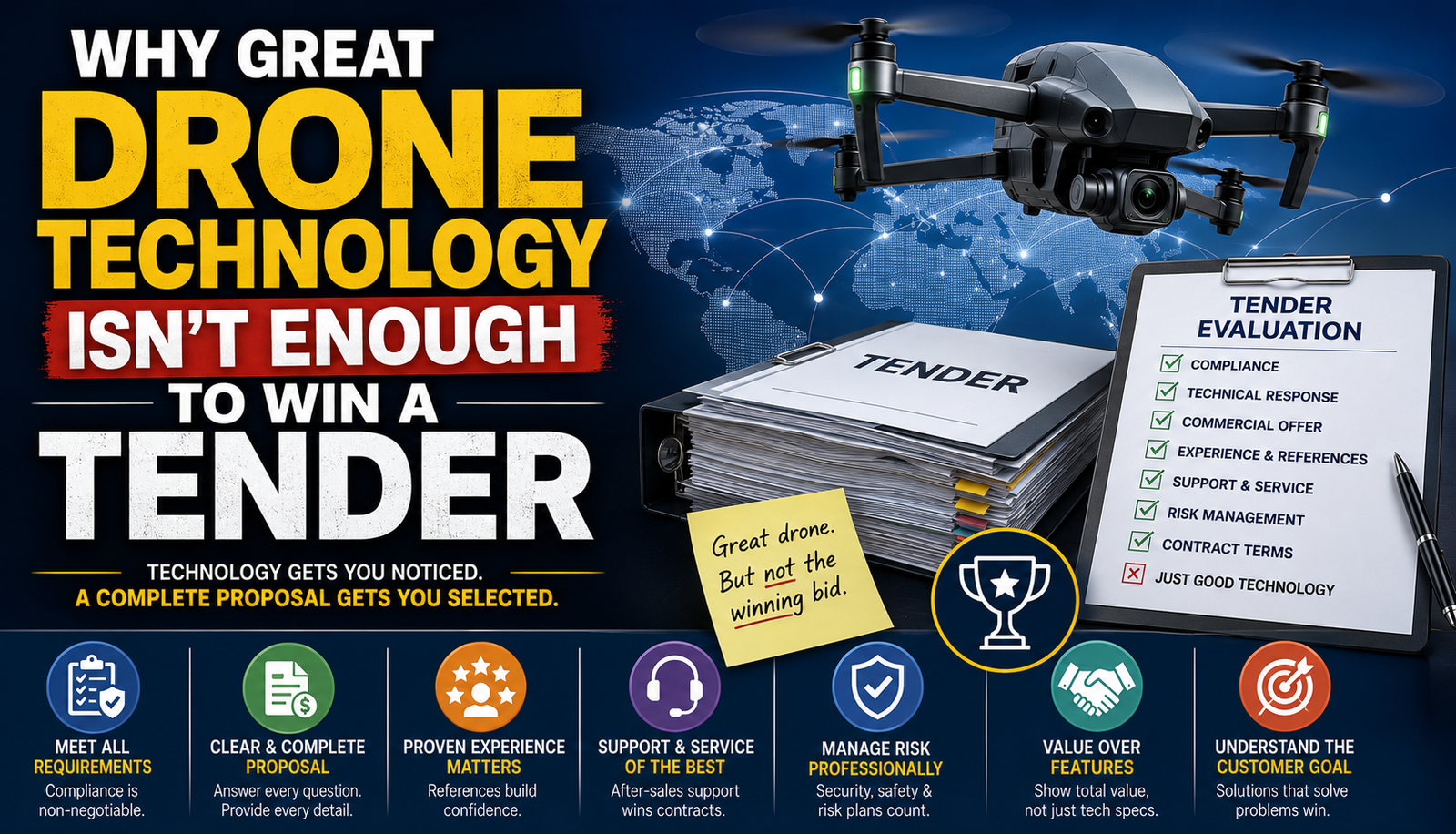
A technically excellent drone can still lose a tender.
That can be frustrating for manufacturers that have invested years in engineering, testing, certifications and product development. From the manufacturer’s perspective, the aircraft may clearly outperform competing systems. It may fly longer, carry more, operate in harsher environments or include more advanced autonomy.
Yet government and commercial procurement decisions are rarely based on one technical specification alone.
Tender evaluators are usually comparing complete solutions. They want confidence that the supplier understands the requirement, can meet every mandatory condition, can deliver on time, can support the customer after the sale and can provide evidence for every important claim made in the proposal.
This means the best technology does not automatically create the best tender.
At Global Drones, we help manufacturers identify suitable opportunities, qualify tenders, prepare and coordinate submissions and support communication with end clients. One of the most important principles in this process is understanding that tender success depends on the complete bid, not simply the aircraft being offered.
Procurement Teams Buy Solutions, Not Specifications
Drone manufacturers naturally think about technical performance. Their teams know the importance of endurance, payload capacity, communications range, flight control, navigation accuracy, sensors, autonomy and reliability.
The customer may care about all of those things, but it is usually trying to solve a broader operational problem.
A fire service does not simply want a drone with a thermal camera. It may want faster situational awareness during an incident.
A utility does not necessarily want the aircraft with the longest endurance. It wants a reliable way to inspect infrastructure safely and efficiently.
A surveying organisation may not be buying LiDAR because the sensor itself is interesting. It wants accurate and repeatable data that fits into an existing workflow.
The tender response therefore needs to explain how the technology solves the customer’s problem.
A list of impressive specifications without operational context can be less persuasive than a proposal that clearly connects technology to outcomes.
For example, instead of only stating that the aircraft can fly for 60 minutes, explain what that endurance allows the customer to achieve. It may reduce battery changes, increase inspection coverage or allow a larger survey area to be completed during one mission.
The strongest proposals translate features into customer value.
Compliance Comes Before Innovation
One of the harsh realities of formal procurement is that a manufacturer can offer a highly innovative system and still be eliminated because of one mandatory requirement.
A tender may include minimum specifications relating to:
- Flight endurance
- Payload capacity
- Operating temperature
- Weather resistance
- Communications range
- Navigation accuracy
- Cybersecurity
- Data storage
- Training
- Warranty
- Delivery
- Insurance
- Certifications
If a requirement is clearly marked as mandatory, the manufacturer generally needs to demonstrate compliance exactly as requested.
Tender evaluators cannot simply ignore the procurement rules because they personally prefer another technology.
This is why technical superiority in one area does not necessarily compensate for non-compliance somewhere else.
A drone might offer exceptional autonomy but fail a mandatory IP-rating requirement. Another could have a better camera but lack a required certification. A manufacturer might provide the best flight performance but fail to submit a requested insurance document.
In formal procurement, these details matter.
A disciplined compliance review is therefore essential before deciding to bid.
The Compliance Matrix Is One of the Most Important Tender Tools
A strong tender process begins by breaking the procurement documentation down into individual requirements.
This is normally captured within a compliance matrix.
For each requirement, the tender team should identify whether the proposed solution is fully compliant, partially compliant or unable to comply. Evidence should also be recorded so that every claim can be supported.
The matrix can include:
- Requirement
- Compliance status
- Supporting evidence
- Responsible person
- Tender response location
- Clarification required
This provides a single view of the entire procurement requirement.
It also prevents something important from disappearing inside a hundred-page tender pack.
At Global Drones, this type of structured review can form part of the tender-management process. Before significant effort is committed to writing the proposal, the manufacturer should know where it stands technically and commercially.
Great Technology Can Be Presented Badly
Another reason strong products lose is poor communication.
Engineers and product teams often understand the technology so well that they assume its advantages are obvious.
They may not be obvious to the evaluator.
Tender responses should not force the customer to interpret vague language or search through brochures.
If the customer asks whether the system can operate in a specified temperature range, answer directly.
If the tender requires a particular payload capacity, provide the figure clearly.
If cybersecurity measures are requested, explain them in the section provided.
A professional tender response should make the evaluator’s job easier.
The customer should be able to see quickly:
- What is being offered
- How it meets the requirement
- What evidence supports the claim
- Who will deliver it
- How it will be supported
Complexity does not necessarily make a proposal stronger. Clarity often does.
Weak Documentation Can Undermine a Strong Product
Manufacturers sometimes underestimate the administrative side of procurement.
Public and large commercial tenders can require a substantial amount of supporting documentation. This is not simply bureaucracy. The customer is assessing whether the supplier is capable of delivering a reliable and compliant solution.
Requests may include:
- Company registration documents
- Insurance certificates
- Product certifications
- Financial information
- Quality policies
- Cybersecurity documentation
- Environmental policies
- Health and safety information
- Warranty terms
- Training information
- Previous project references
- Signed declarations
If these documents are missing, outdated or inconsistent, confidence in the manufacturer can fall quickly.
This is especially problematic when competitors arrive with complete and professionally organised submissions.
A company may have better technology but appear less procurement-ready.
That creates unnecessary risk in the evaluator’s mind.
References Matter More Than Many Manufacturers Expect
Customers want proof that the supplier can deliver.
A technical datasheet proves what the product is designed to do. A reference project demonstrates that the manufacturer has successfully delivered similar technology in the real world.
That distinction is important.
Government and infrastructure customers may be purchasing equipment that will become part of critical operations. They want to know whether the supplier has experience with comparable organisations and environments.
Strong references should explain:
- The customer
- The operational requirement
- The system supplied
- The deployment process
- Training provided
- Technical support
- Results achieved
Where possible, measurable outcomes are particularly useful.
A generic statement saying “we supplied drones to a utility company” is less powerful than explaining how the system was deployed, what problem it solved and what operational result the customer achieved.
Manufacturers should therefore document successful projects as carefully as they document technical specifications.
Training Can Be a Competitive Advantage
Manufacturers often focus heavily on hardware and treat training as a small add-on.
For many public-sector customers, training is central to the procurement.
A drone that performs brilliantly during a manufacturer-led demonstration may still be unsuitable if the customer cannot deploy it confidently after delivery.
The tender should therefore explain how users will become operational.
Training information may cover:
- Initial operator training
- Administrator training
- Maintenance training
- Refresher courses
- Training material
- Online resources
- Certification where applicable
- Train-the-trainer programs
Customers want to understand how quickly their teams can use the system effectively.
Manufacturers that present a structured training plan can reduce customer risk and differentiate themselves from competitors offering hardware alone.
Support After the Sale Is Part of the Product
The sale does not end when the drone arrives.
Government organisations, utilities and other professional customers may expect the technology to remain operational for years.
This makes after-sales support an important part of the tender evaluation.
The customer may want to understand:
- How technical support is accessed
- Response times
- Repair procedures
- Spare-parts availability
- Software updates
- Warranty claims
- Escalation procedures
- Local support availability
A manufacturer with excellent technology but weak support can appear risky.
A slightly less advanced system backed by clear support, training and maintenance may be more attractive to the procurement team.
This is why the total customer experience matters.
Cybersecurity Is Becoming Part of Technical Compliance
Modern drones are connected systems.
They communicate with ground stations, mobile devices, networks and cloud platforms. They collect potentially sensitive data and may operate around critical infrastructure or public-safety incidents.
For many customers, cybersecurity is therefore becoming as important as flight performance.
Tender requirements may ask about:
- Data encryption
- Communication security
- User authentication
- Software updates
- Data storage
- Cloud infrastructure
- Vulnerability management
- Component origin
- Access controls
- Supply-chain security
A manufacturer may have a technically excellent aircraft but fail to explain these areas adequately.
That can reduce the score or even create a compliance issue.
Companies targeting government and critical-infrastructure customers should develop clear cybersecurity documentation before tenders arrive.
Delivery Risk Can Cost You the Contract
Procurement teams do not only evaluate whether the drone works.
They also evaluate whether the manufacturer can actually deliver the project.
A manufacturer may promise aggressive lead times in order to make its offer more attractive. If those deadlines are unrealistic, the proposal carries risk.
Before committing to a delivery date, the manufacturer should consider:
- Manufacturing capacity
- Component lead times
- Payload availability
- Software configuration
- Export licensing
- Shipping
- Customs
- Installation
- Training
- Acceptance testing
The tender should contain a credible delivery plan.
A realistic schedule supported by clear milestones often creates more confidence than an optimistic promise with little explanation.
Price Is Important, but It Is Rarely the Whole Story
Manufacturers sometimes assume the lowest price will win.
In many procurement processes, price is only one evaluation category.
The customer may score bids across technical quality, support, delivery, training, warranty, experience and commercial terms.
This means manufacturers need to understand the scoring methodology.
If technical quality represents a large percentage of the evaluation, simply cutting the price may not compensate for a weak response.
Likewise, an expensive proposal may still win if it clearly demonstrates better value, lower operational risk and stronger long-term support.
Manufacturers should focus on the total solution.
This can include:
- Aircraft
- Payload
- Software
- Training
- Maintenance
- Support
- Warranty
- Spare parts
- Delivery
The proposal should make it easy for the buyer to understand what it is receiving and why the overall package represents value.
Generic Proposals Usually Perform Poorly
A common mistake is reusing a previous proposal without adapting it properly.
Using templates is sensible. Reusable content can dramatically reduce tender preparation time.
However, templates should be a starting point rather than the final response.
Every customer has a different requirement.
The proposal should refer directly to the organisation’s operational needs, terminology and evaluation criteria.
A generic response can make it look as though the manufacturer does not fully understand the project.
The strongest tenders combine reusable approved material with customer-specific content.
Manufacturers should therefore maintain a tender library containing standard information while ensuring every final submission is adapted to the opportunity.
Poor Bid Management Creates Avoidable Mistakes
Even strong companies can lose tenders because nobody clearly owns the process.
Tender preparation often requires input from multiple departments.
Engineering provides technical information.
Finance provides pricing.
Legal may review contract terms.
Operations confirms delivery.
Management approves commercial commitments.
If this process is unmanaged, important tasks can be delayed or missed.
A tender manager should coordinate:
- Requirements
- Responsibilities
- Internal deadlines
- Document collection
- Reviews
- Approvals
- Submission
The official procurement deadline should not be the internal deadline.
A professional bid process creates enough time for review and corrections before submission.
The Final Review Can Make the Difference
Before any tender is submitted, it should undergo a complete quality review.
This should not only focus on spelling and formatting.
The team should confirm that:
- Every mandatory question is answered
- All required documents are included
- Technical information is accurate
- Pricing matches the technical configuration
- Certificates are current
- Delivery commitments are approved
- Contract terms have been reviewed
- Signatures are complete
- File formats meet the instructions
- The submission is internally approved
The compliance matrix should be reviewed one final time.
This simple discipline can prevent avoidable disqualification.
Demonstrations Need to Match the Tender Promise
Some tenders include a demonstration or evaluation stage.
This can be an excellent opportunity for drone manufacturers because technology is often easier to understand when it is seen operating.
However, demonstrations create another risk.
If the tender response claims that a system can perform a particular task, the demonstration may be used to verify it.
Manufacturers should therefore prepare carefully.
The demonstration should focus on the customer’s use case rather than becoming a general product showcase.
Show how the technology solves the requirement.
If the customer is evaluating infrastructure inspection, demonstrate the inspection workflow. If the requirement relates to emergency response, show how quickly the system can deploy and provide useful information.
The more relevant the demonstration is to the operational problem, the stronger the manufacturer’s position becomes.
Great Tender Responses Reduce Customer Risk
Ultimately, procurement teams are trying to make a decision they can defend.
They need confidence that the selected supplier will deliver what has been promised.
A strong tender response reduces uncertainty.
It shows that the manufacturer:
- Understands the requirement
- Meets the specification
- Has relevant experience
- Can deliver
- Can train users
- Can support the technology
- Has appropriate documentation
- Can operate professionally
This is why tender success is about more than the aircraft itself.
The technology is essential, but the proposal needs to prove that the manufacturer can turn that technology into a reliable operational capability.
Become Tender-Ready Before the Opportunity Arrives
Manufacturers should not wait until an attractive procurement opportunity appears before organising their tender documentation.
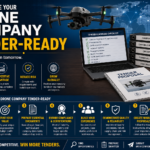
A tender-ready company maintains a central library of approved information.
This should include:
- Product datasheets
- Technical specifications
- Company information
- Certifications
- Insurance documents
- Warranty policies
- Training information
- Support procedures
- Cybersecurity material
- Customer references
- Case studies
- Standard tender responses
Keeping this information current can significantly reduce preparation time.
When a suitable opportunity appears, the manufacturer can focus on producing a strong customer-specific proposal instead of spending days searching for basic documentation.
How Global Drones Can Help
Global Drones helps drone manufacturers, payload manufacturers, software providers and related technology companies identify and pursue tender opportunities worldwide.
Our role begins with opportunity discovery.
Manufacturers joining our Manufacturer Program provide information about their technology, applications and target markets. This allows Global Drones to identify procurement opportunities that are more relevant to their capabilities.
When an opportunity appears, we can support the qualification process before the manufacturer commits significant resources.
For suitable tenders, Global Drones can assist with:
- Opportunity qualification
- Bid/No-Bid coordination
- Compliance reviews
- Tender document preparation
- Document management
- Submission coordination
- Deadline management
- End-client communication
- Clarification support
The manufacturer remains responsible for approving its technical specifications, pricing, contractual terms, product delivery, training, warranties and after-sales support.
Our objective is not to replace the manufacturer. It is to provide additional tender capability so the manufacturer can compete for more opportunities internationally.
Strong Technology Gets You Into the Competition
Great technology remains essential.
A manufacturer without a competitive product will struggle regardless of how professionally the tender is written.
But strong technology is only the starting point.
To win consistently, manufacturers also need strong documentation, clear compliance, professional bid management, customer references, credible delivery plans and reliable support.
The winning proposition is therefore not simply:
“We have the best drone.”
It is:
“We have the right technology, we understand your requirement, we can prove compliance, and we can successfully deliver and support the complete solution.”
That is a much stronger procurement message.
Turn Great Technology Into Winning Proposals
Drone manufacturers invest enormous amounts of time and money developing technology capable of solving real operational problems.
The tender response should represent that technology just as professionally.
A poorly organised submission can prevent customers from recognising the value of an excellent product. A strong bid makes that value clear, reduces customer risk and gives evaluators the evidence they need to select the solution.
For manufacturers pursuing government, infrastructure, utility, research, security and other professional markets, tender capability should therefore be treated as an important part of the commercial organisation.
Global Drones helps manufacturers find suitable opportunities and turn their technical capabilities into structured, competitive tender submissions.
If your company manufactures drones, payloads, sensors, software or related technology and wants to pursue more international procurement opportunities, join the Global Drones Manufacturer Program.
Great technology gets you noticed. A great tender helps you win.