For many drone manufacturers, international growth begins with distributors. The model is familiar: identify a capable local partner, provide product information and pricing, support demonstrations, and rely on that distributor to generate opportunities in its territory.
When the relationship works well, distributors can become a powerful route to market. They understand local customers, speak the language, provide regional support and can often accelerate market entry significantly.
The challenge is that distributor-led growth has limits.
A manufacturer may appoint partners in several countries but still have little visibility into what those partners are actually pursuing. Some distributors are highly proactive, while others wait for inbound enquiries. Some understand the manufacturer’s technology deeply, while others represent dozens of products and naturally prioritise whichever opportunities are easiest to close.
This can leave manufacturers with large gaps in international coverage.
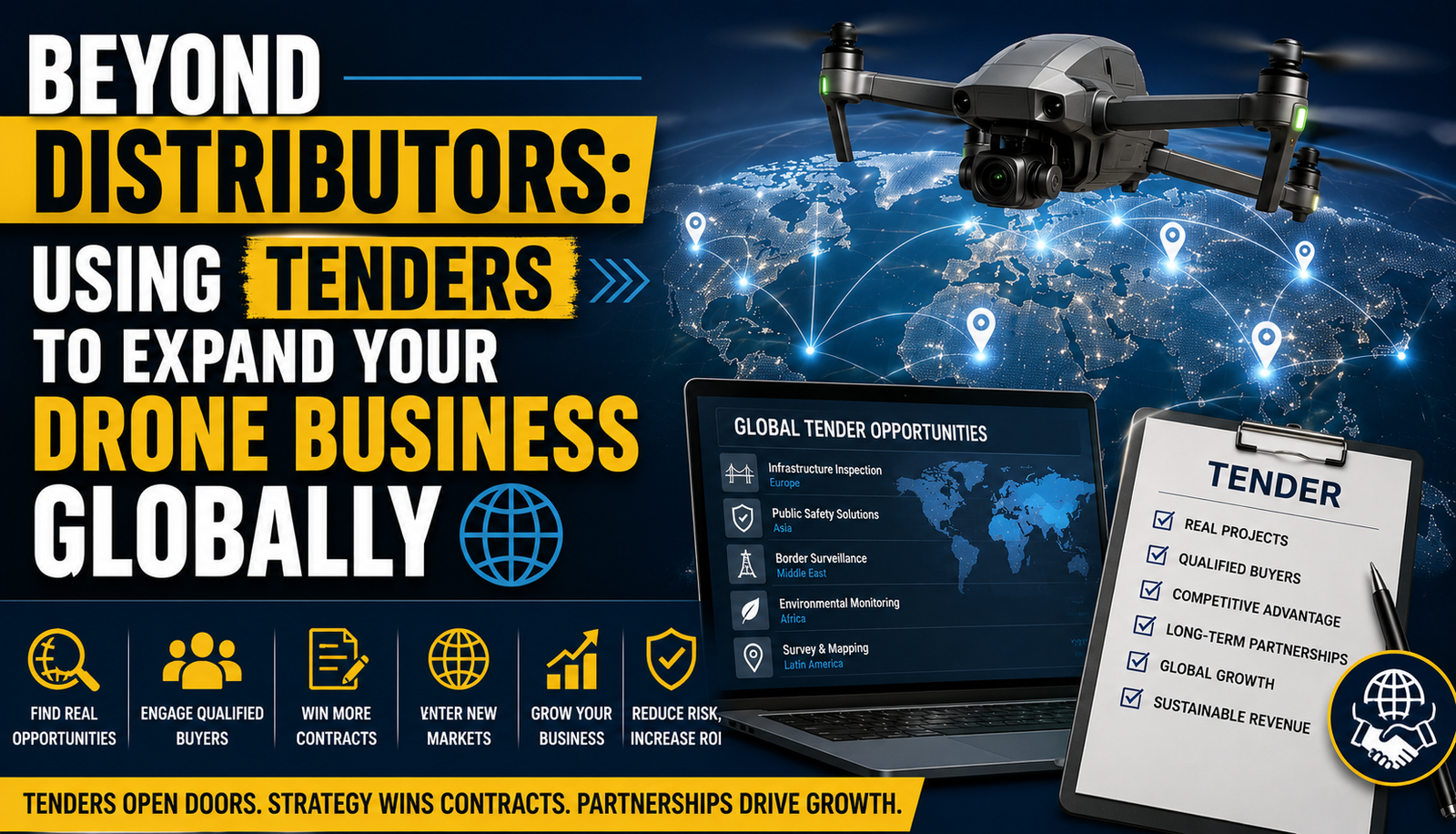
Public and private tenders provide another route to global expansion. Rather than relying entirely on local distributors to find business, manufacturers can actively identify organisations that are already looking to purchase drone technology and then decide the best way to pursue each opportunity.
At Global Drones, we see tenders as a way to complement distribution rather than replace it. By identifying relevant opportunities globally, qualifying them, supporting tender preparation and connecting manufacturers with end clients and local partners, manufacturers can build a more active and opportunity-driven international sales strategy.
Why Distributor-Only Growth Can Become Restrictive
Distributors remain extremely important in the drone industry, particularly when local demonstrations, language support, training, maintenance or customer relationships are required.
However, manufacturers can become too dependent on them.
A distributor may cover an entire country but only actively work within two or three industries. Another may have excellent commercial relationships but limited understanding of government procurement. A third might focus heavily on products from another supplier.
From the manufacturer’s perspective, that creates uncertainty.
The company may know that it technically has representation in a country, but it may not know whether important procurement opportunities are being identified or pursued.
Distributor performance can also vary over time. Staff changes, market conditions, competing priorities and internal restructuring can all affect activity.
For manufacturers trying to grow globally, the key question becomes:
How do we maintain local channel coverage while also creating our own visibility into real opportunities?
Tender intelligence can provide part of the answer.
Tenders Put Opportunity Discovery Back in the Manufacturer’s Control
A traditional distributor model often places responsibility for opportunity generation with the local partner.
The manufacturer supports when an opportunity appears.
Tender monitoring reverses this dynamic.
Instead of waiting for the distributor to identify a project, the manufacturer or its tender partner can discover the opportunity first.
The process becomes:
- A relevant tender is identified.
- The opportunity is matched to the manufacturer.
- The tender is qualified.
- The manufacturer decides whether to proceed.
- A local distributor or partner is involved where useful.
- The bid is prepared and submitted.
- The manufacturer supports the technical and commercial process.
This gives the manufacturer greater visibility into international demand.
It also allows the company to become more proactive with its channel network.
Instead of asking a distributor, “Do you have any opportunities?”, the conversation can become:
“We have identified a qualified tender in your territory. Can you support the customer relationship and local requirements?”
That is a much stronger starting point.
Use Tenders to Identify Which Markets Deserve More Investment
Expanding internationally requires investment, but manufacturers do not always know where that investment should go.
A company might receive enquiries from dozens of countries, but enquiries alone do not necessarily indicate a strong market.
Tender activity provides another data point.
If repeated procurement opportunities begin appearing in a particular country or region, that suggests organisations there are actively buying technology similar to yours.
Over time, manufacturers can identify where demand is strongest.
For example, a manufacturer may discover increasing tender activity for:
- Infrastructure inspection in Germany
- Public safety drones in the United Kingdom
- Environmental monitoring in Scandinavia
- Mining applications in Australia
- Defence and security applications in Eastern Europe
- Surveying and mapping systems in the Middle East
This information can help determine where to invest in distributors, demonstrations, exhibitions, local support or regulatory work.
The manufacturer is no longer choosing markets purely based on general market reports. It is using real procurement activity.
Tenders Can Help You Test a Market Before Building a Full Channel
Building a distributor network takes time.
The manufacturer needs to identify potential partners, evaluate them, negotiate agreements, provide training and support launch activity.
That investment makes sense when the market is attractive, but it can be difficult to know whether the territory will generate enough business.
Tenders provide a way to test demand earlier.
If an attractive procurement opportunity appears in a country where the manufacturer has no distributor, the company can evaluate the opportunity first.
If it is worth pursuing, the manufacturer can then determine what local support is actually required.
That might involve:
- Appointing a local commercial agent
- Partnering with a specialist reseller
- Using a local tender consultant
- Finding a service partner
- Working with a system integrator
- Bidding directly if foreign suppliers are permitted
The opportunity itself becomes the reason to build the relationship.
This can be more efficient than appointing partners broadly and waiting to see whether business appears.
Strengthen Good Distributors With Better Opportunities
Tender-led growth should not be seen as a threat to strong distributors.
In fact, it can make them more productive.
Imagine a manufacturer has a capable reseller in France. The reseller understands local customers and can support demonstrations and training, but its team has limited time to monitor every public procurement portal.
Global Drones identifies a relevant French tender and matches it to the manufacturer.
The opportunity can then be shared with the reseller.
The reseller gains a qualified local lead.
The manufacturer provides product expertise.
Global Drones supports the tender process.
The end client receives local support.
Everyone benefits.
This is a much stronger channel model than expecting the reseller to do everything.
Manufacturers can effectively provide their distributors with additional business-development support rather than simply asking them to generate more sales.
Build a More Active Channel Strategy
Many manufacturers manage distributors reactively.
Quarterly conversations often revolve around questions such as:
- What opportunities do you have?
- What demonstrations have you completed?
- What is your forecast?
- What support do you need?
Tender intelligence adds a proactive layer.
Manufacturers can identify opportunities and assign them to the most suitable partner.
That makes the channel network more structured.
A central tender system could track:
- Country
- Customer
- Tender reference
- Estimated contract value
- Assigned manufacturer
- Assigned distributor
- Submission deadline
- Current status
- Probability of success
- Next action
This creates visibility across the international network.
The manufacturer can see where activity is happening, which distributors are engaging and where new partners may be required.
Reduce Dependence on a Small Number of Partners
One of the risks of international distribution is overdependence.
A manufacturer may generate a large percentage of revenue through one or two major partners.
If those relationships change, the commercial impact can be significant.
Tender-led business development creates another source of opportunities.
The manufacturer may still use local partners, but the opportunity pipeline no longer depends entirely on them.
This helps create a more balanced international sales structure combining:
- Direct sales
- Distributors
- Resellers
- Commercial agents
- Strategic partners
- Tender opportunities
- End-client relationships
The objective is not to remove partners from the process.
It is to make sure the manufacturer retains visibility into demand and can actively influence where opportunities come from.
Reach Customers Your Distributor Network May Never Find
Even a strong distributor network has limits.
A reseller specialising in surveying may know many survey companies but very few fire services. A defence-focused partner may have no relationships with universities. An industrial integrator may not monitor environmental procurement.
Yet the same drone platform may be suitable for several of these markets.
Tender monitoring provides visibility beyond the distributor’s existing customer base.
Relevant opportunities can come from organisations such as:
- Utilities
- Emergency services
- Universities
- Research organisations
- Police
- Defence
- Forestry agencies
- Environmental authorities
- Ports
- Airports
- Rail operators
- Municipalities
This can expose manufacturers to entirely new applications and sectors.
Over time, that may influence which distributors or specialist partners the manufacturer recruits.
Use Tender Intelligence to Evaluate Distributor Performance
Tender data can also help manufacturers understand whether their channel coverage is genuinely effective.
Suppose multiple opportunities appear in a distributor’s territory, but the distributor never identifies them independently and shows little interest when they are shared.
That provides useful information.
Perhaps the distributor is not focused on that market. Perhaps it lacks the resources to pursue government procurement. Or perhaps another partner would be more suitable.
Conversely, a distributor that responds quickly, builds local relationships and supports submissions effectively may deserve more investment.
Tender activity therefore creates another way to evaluate channel performance based on real market opportunities.
Expand Into New Industries, Not Just New Countries
Global expansion is not only geographic.
A manufacturer may already operate in several countries but remain concentrated within one industry.
Tender intelligence can reveal opportunities in entirely new sectors.
For example, a company known for mapping drones might identify requirements from:
- Forestry agencies
- Utilities
- Environmental organisations
- Mining companies
- Rail operators
- Universities
A manufacturer focused on inspection could discover opportunities within public safety or emergency response.
This can lead to new application strategies, partnerships and marketing campaigns.
The manufacturer may ultimately decide that certain industries require specialist distributors rather than general drone resellers.
Tender intelligence therefore supports both geographic and vertical expansion.
Why Local Representation Still Matters
There are many cases where local representation remains valuable or necessary.
Customers may expect local language support. Demonstrations may need to happen quickly. Some tenders may require local registration, local servicing or authorised representation.
This is why the strongest approach is usually hybrid.
Global tender management provides international opportunity discovery and central coordination.
Local partners provide market access, relationships and support where necessary.
The manufacturer provides the technology, technical expertise, commercial terms and customer contract.
This creates a scalable structure without requiring the manufacturer to employ its own team in every country.
The Role of Global Drones
Global Drones is designed to operate as a tender and market-access partner for drone manufacturers.
Manufacturers join our Manufacturer Program and provide information about their systems, applications and target markets.
We then identify relevant public and private tender opportunities globally and match them against participating manufacturers.
When an opportunity is worth pursuing, we can support:
- Tender qualification
- Bid/No-Bid coordination
- Document preparation
- Compliance management
- Deadline management
- Submission support
- Local partner coordination
- End-client communication
Where a manufacturer already has a distributor, that partner can be incorporated into the opportunity.
Where no local representation exists, the manufacturer can decide whether a country partner is required.
The model is designed to increase international sales coverage without removing the manufacturer from the commercial relationship.
The Manufacturer Still Owns the Customer Relationship
An important principle of the Global Drones model is that the manufacturer remains responsible for the commercial sale.
Global Drones helps create and manage the opportunity.
The manufacturer remains responsible for:
- Technical specifications
- Product demonstrations
- Pricing
- Quotations
- Contract negotiation
- Contract signing
- Product delivery
- Training
- Warranty
- After-sales support
This structure allows manufacturers to expand opportunity generation while keeping control of the most important customer and product responsibilities.
Build a Tender-Ready Channel Network
The strongest international model is not simply having more distributors.
It is having the right partners connected to a central opportunity-management process.
Manufacturers should know:
- Which partner covers each country
- Which industries they specialise in
- Whether they support public procurement
- Whether they can provide demonstrations
- Whether they can provide technical support
- Whether they can act as the local bidder if necessary
- How commission is structured
- How opportunities are registered
This information can then be linked to the tender pipeline.
When a new opportunity appears, the manufacturer immediately knows which local partner can help.
That reduces delays and improves consistency.
Avoid Channel Conflict
A more active tender strategy needs clear rules.
If Global Drones identifies an opportunity in a territory where the manufacturer already has a distributor, everyone should understand how that opportunity will be managed.
The manufacturer should define:
- Who owns the customer relationship
- Who supports the tender
- Who provides local support
- Whether the distributor receives commission
- Whether Global Drones receives commission
- How the opportunity is registered
- How future sales from the customer are handled
Clear opportunity registration is essential.
Without it, disputes can arise later when several parties claim responsibility for the same sale.
A structured CRM or tender platform can provide a timestamped record of who identified the opportunity and who is responsible for each stage.
Grow Through Opportunities, Not Just Territories
Traditional distribution strategies are often built around maps.
Germany belongs to one distributor. France belongs to another. Australia belongs to another.
That remains useful, but tender-led growth introduces another way of thinking.
Instead of focusing only on territories, focus on opportunities.
A manufacturer might discover that the best opportunities in a particular year come from electricity utilities in Northern Europe, emergency services in the UK and universities in Australia.
Commercial resources can then follow those opportunities.
This creates a more dynamic international strategy.
The manufacturer still builds long-term channel relationships, but market development becomes driven by actual customer demand.
Use Tenders to Create a Global Sales Engine
The long-term goal should be to create a repeatable system.
Global opportunity discovery feeds the manufacturer’s pipeline.
Each opportunity is qualified.
The strongest tenders move into bid preparation.
Local partners become involved where appropriate.
The manufacturer engages directly with the customer when technical and commercial discussions begin.
If the tender is won, the manufacturer contracts, supplies and supports the customer.
The workflow becomes:
Global Tender Discovery → Qualification → Local Partner → Tender Submission → Manufacturer Engagement → Contract → Delivery
This is considerably more scalable than relying entirely on distributors to independently generate every opportunity.
A Better Model for International Drone Sales
There is no reason manufacturers need to choose between distributors and tenders.
The strongest model can use both.
Distributors provide local knowledge, relationships and support.
Tender intelligence provides proactive opportunity discovery.
Central tender management provides structure.
The manufacturer retains control of technology, pricing and customer delivery.
Together, these elements create a broader and more resilient international sales strategy.
Manufacturers can see where demand exists, activate local partners around genuine opportunities and enter new markets based on actual procurement activity.
Global Drones: Expanding Your Reach Beyond Traditional Distribution
Global Drones helps drone manufacturers, payload companies, software providers and related technology businesses identify and pursue international tender opportunities.
We work alongside existing distributors rather than replacing them.
Our role is to help manufacturers find more opportunities, manage the tender process and connect with end clients around the world.
By combining global tender intelligence with local channel partners, manufacturers can increase market coverage without building large internal sales teams in every country.
If your company wants to expand internationally while maintaining control of its products, pricing, contracts and customer support, join the Global Drones Manufacturer Program.
Build the right channel. Find the right opportunities. Grow globally.